
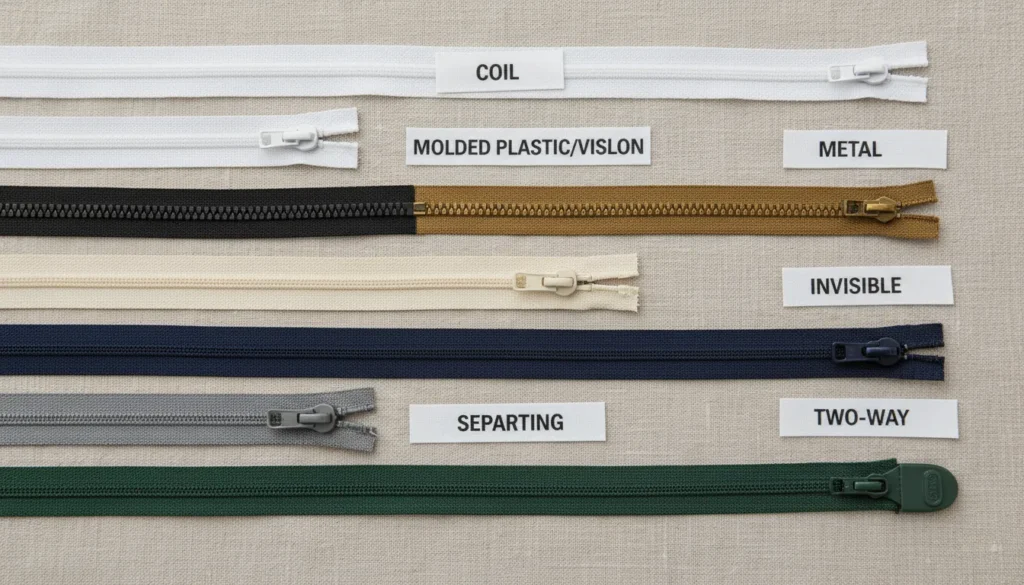
You’re halfway through a project, everything’s looking clean… and then the zipper fights you. I’ve been there—installing what I thought was the “right” zipper into a pouch, only to realize the coil was too light for the stress points and the slider started separating after a week. The good news: once you understand 7 zippers (the most common zipper types you’ll actually buy and sew), choosing becomes fast and almost boring—in the best way.

What “zipper numbers” mean (and yes, there is a #7 zipper)
Zipper “numbers” like #3, #5, #7, #8, #9 refer to the approximate width of the zipper teeth when zipped, measured in millimeters. In plain terms:
- Smaller number = lighter duty + cleaner look (common in dresses, pockets)
- Bigger number = stronger + more visible (common in bags, jackets)
So, is there a number 7 zipper? Yes—#7 zippers exist (often in metal like antique brass) and are a nice “in-between” for outerwear and structured projects: heavier than many standard garment zippers, but not as chunky as extra-heavy bag zippers.
Also, quick clarification because search results get messy: “7-Zip” is file compression software, not a sewing zipper. If you’re here for stitches, ignore the computer stuff.
The 7 zippers you’ll actually use (and when to pick each)
Below are 7 zippers worth knowing, compared in practical sewing terms. Think of this as a toolkit: you don’t need every zipper type for every build—you just need the right one for stress, fabric, and finish.
1) Nylon coil zipper (the most versatile)
Nylon coil zippers flex, curve, and handle daily use well, which is why I reach for them in pouches, cushions, and many garments. They’re also easier to sew over than chunky teeth, especially if you’re topstitching close to the edge. If you want one “default zipper,” coil is it.
Best for:
- Pouches, cosmetic bags, pillow covers
- Curved seams and lightweight-to-medium fabrics
Watch-outs:
- Ultra-heavy loads (large duffels) may need bigger sizes (#8/#10 coil)
2) Molded plastic zipper (often called Vislon-style)
Molded plastic teeth are chunky, slide smoothly, and resist corrosion—great for outdoor gear. They’re stiffer than coil, so they don’t love tight curves, but they shine on jackets and athletic wear where you want reliable separating action.
Best for:
- Jackets, hoodies, outdoor gear
- Projects needing durability without metal
Watch-outs:
- Not ideal for tight-radius curves
3) Metal zipper (classic, strong, visible)
Metal zippers look premium and wear in beautifully—especially brass or antique finishes. If your project is leather, denim, or heavy canvas, metal can be the right aesthetic and strength choice. Just remember: metal teeth add bulk and can be harder to sew precisely.
Best for:
- Leather jackets, denim, heavy bags
- Style-forward closures
Watch-outs:
- Bulk at seams; can scratch delicate fabrics
4) Invisible zipper (for a clean “no-zipper” look)
Invisible zippers are the go-to for dresses, skirts, and fitted projects because the teeth roll to the underside and disappear in the seam. They’re not the strongest type, but they’re unbeatable for a polished finish when the zipper shouldn’t be the star.
Best for:
- Dresses, skirts, formalwear, pillow covers with hidden closure
Watch-outs:
- Requires correct invisible zipper foot technique for best results
5) Closed-end zipper (non-separating)
Closed-end zippers have a bottom stop and don’t split apart—perfect for pants, pockets, and many bags. This is also where zipper length questions come up: a 7-inch zipper usually measures about 7 inches stopper-to-stopper (and may be longer overall including tape). Many are trimmable, but you must re-create a stop if you cut past one.
Best for:
- Trousers, pockets, pouches, cushion covers
- Any closure that shouldn’t separate fully
Watch-outs:
- Don’t buy separating by mistake for these jobs
6) Separating zipper (open-end, jacket style)
Separating zippers split fully at the bottom—your classic jacket zipper. If you’re making coats, hoodies, or costumes, this is usually the right construction. Heavier jackets often use #7, #8, or #10 depending on weight and style.
Best for:
- Jackets, coats, robes, costumes
Watch-outs:
- Insertion pin + box need accurate alignment (especially on thick fabrics)
7) Water-resistant zipper (PU-coated / “weather zip”)
These have a coated tape that helps shed water and blocks wind. They’re common on rainwear and tech packs. They can feel stiffer and may require slightly longer stitch length and careful pinning/clipping to avoid puckers.
Best for:
- Rain jackets, bike gear, outdoor bags
Watch-outs:
- Stiffer handling; topstitching needs patience for a flat finish
Zipper Shopping: What You Need to Know to Make the Right Choice!
Quick comparison table: 7 zippers at a glance
| Zipper type | Typical strength | Best for | Sewing difficulty | Notes |
|---|---|---|---|---|
| Nylon coil | Medium | Pouches, cushions, curved seams | Easy | Flexible; great all-rounder |
| Molded plastic | Medium–High | Jackets, outdoor wear | Medium | Stiffer; smooth sliding |
| Metal | High | Denim, leather, heavy bags | Medium–Hard | Premium look; bulky at seams |
| Invisible | Low–Medium | Dresses, skirts, clean seams | Medium | Needs correct foot/technique |
| Closed-end | Varies by size | Pants, pockets, pouches | Easy | Doesn’t split at bottom |
| Separating (open-end) | Medium–High | Jackets, coats | Medium | Must align box/pin accurately |
| Water-resistant | Medium–High | Rainwear, tech bags | Medium | Coated tape; stiffer feel |
How to choose the right zipper size (#3, #5, #7, #8, #9) without overthinking
People often ask “What does a number 5 zipper mean?” It’s mainly about tooth width and intended load. In practice, I use this simple decision rule:
-
Start with the project category
- Apparel seams (dresses/skirts): usually #3 invisible or #3 coil
- Everyday pouches and small bags: usually #5 coil
- Outerwear and heavier closures: #7 or #8
- Rucksacks/duffels and high-load bags: #8 or #9
-
Match the zipper to the fabric weight
- Light fabric + heavy zipper = rippling and distortion
- Heavy fabric + light zipper = stress failures at stops and seams
-
Pick the finish last
- Choose metal vs molded vs coil based on look, corrosion needs, and handling
What is a number 8 zipper? Typically a heavier-duty zipper with teeth around 8 mm wide when zipped—common in separating “jacket” zippers and sturdy bag builds.
Is there a #9 zipper? Yes—often used for bags/rucksacks; tape is usually wider and more robust than lighter sizes.

Pro installation tips (the stuff that prevents zipper rage)
These are the habits that made the biggest difference for me across 7 zippers and dozens of materials:
- Stabilize first, sew second
- Add lightweight interfacing along the zipper area on unstable fabrics to prevent waves.
- Use the right foot
- Zipper foot for coil/metal/molded; invisible zipper foot for invisible zips.
- Control bulk
- Grade seam allowances and press before topstitching—especially with metal teeth.
- Mind the slider direction
- Decide whether you want the pull inside/outside before stitching it in (sounds obvious; still easy to miss).
- Test stitch length
- Coated/water-resistant zips often behave better with a slightly longer stitch length.
Where makers get zippers (and how to shop smarter)
If you’re building a kit, buying a small range (e.g., #3 invisible, #5 coil, #7 separating, #9 bag zip) covers most needs. For deal-hunting and local sourcing, this guide helps you time purchases and compare options: Crafts Stores Near Me: 7 Ways to Find the Best Deals.
For deeper zipper basics and standards, these references are useful:
- YKK: Zipper Knowledge & Product Info
- Coats: Zips and Fastenings (product guidance)
- Textile Institute (professional textile education)
Bonus: When laser-cutting and fabrication tools help zipper projects (xTool angle)
Zippers are “soft goods,” but modern making is mixed-material now. I’ve used digital fabrication to speed up zipper-based products in three ways:
- Clean pattern templates
- Laser-cut acrylic templates for zipper pockets and gussets keep cuts consistent across batches.
- Professional labeling
- Engrave metal zipper pulls, bag tags, or branding plates for a retail-ready finish.
- Jigs for repeatability
- Cut placement jigs so zipper positions stay identical across production runs.
If you’re building zipper pouches, backpacks, or jackets as products—not just one-offs—tools from xTool’s ecosystem (laser cutting/engraving + software workflows) can help you prototype faster and scale cleaner.

Conclusion: pick the zipper that matches the job (and your patience)
If your project needs a hidden finish, go invisible. If it curves, coil is usually safest. If it’s outerwear, separating in #7–#8 is often the sweet spot. And if it’s a high-load bag, step up to #8–#9 and build the seam to match. The fastest way to enjoy sewing 7 zippers is accepting that the “best zipper” is simply the one designed for your stress level, fabric weight, and look.
FAQ (People Also Ask)
1) Is there a number 7 zipper?
Yes. #7 zippers are commonly used for heavier jackets and structured projects—often in metal finishes like antique brass.
2) How long is a 7 inch zipper?
Typically 7 inches from stopper to stopper, with a longer overall tape length. Many are trimmable, but you may need to add a new stop after shortening.
3) What does a number 5 zipper mean?
It refers to tooth width (about 5 mm when zipped) and generally indicates a medium-duty zipper used often in pouches, small bags, and everyday items.
4) What is a number 8 zipper used for?
Often used for jackets and sturdier bags, with larger teeth and higher strength than #5. Many #8 zippers are separating jacket-style.
5) What does “7 zip” mean?
In many searches, “7-Zip” refers to file compression software, not sewing. For sewing, “#7 zipper” means a zipper size category.
6) How do I tell what size my zipper is?
Measure the tooth width while zipped (in mm) or check the back of the slider (many are stamped). When replacing a slider, matching the zipper size and type (coil vs molded vs metal) matters.