
Let's break down what a low MOQ clothing manufacturer actually is. Forget the traditional factory model that demands you order thousands of pieces. We're talking about a production partner that lets you start with small, manageable batches—think anywhere from 30 to 300 units per style.
For new designers, independent labels, and DTC brands, this isn't just a nice-to-have; it's a lifeline. It's how you test-drive a new design, keep your cash flow from flatlining, and avoid the crippling risk of being buried in unsold inventory.
Why Low MOQ Is Your Brand’s Strategic Advantage
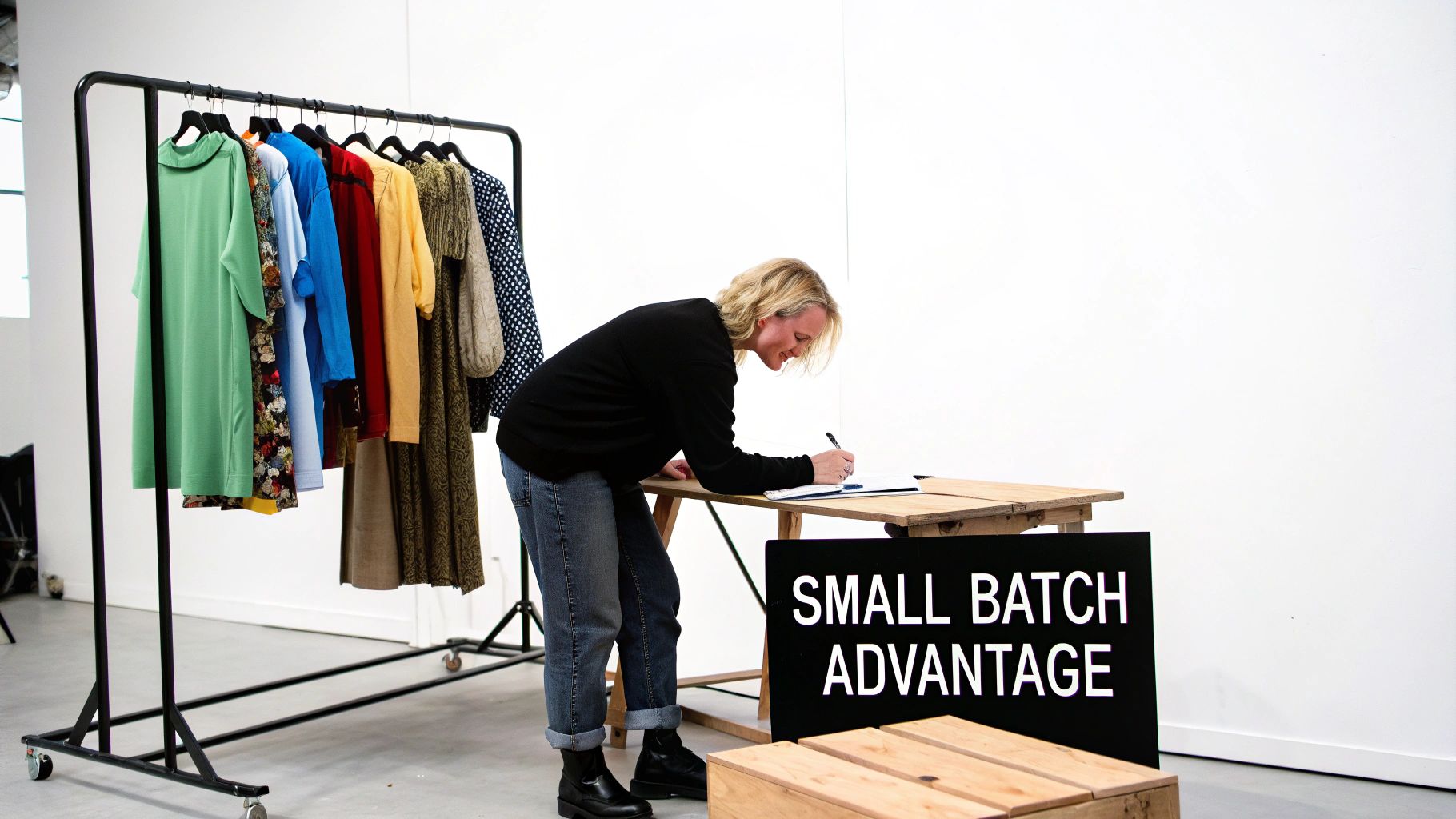
Shifting away from high-volume manufacturing isn't just a fleeting trend. It's a fundamental strategic move for any modern fashion brand trying to make its mark. The old playbook of betting your entire budget on one massive production run is broken. Working with a low MOQ clothing manufacturer gives you a much smarter, more agile way to grow.
The biggest, most immediate win is how it slashes your financial risk. Instead of locking up every last dollar in thousands of units that might sell, you can channel that capital back into marketing, R&D, or just keeping the lights on. It keeps your business nimble and your cash flow positive.
By producing only what you need, you transform inventory from a potential liability into a strategic asset. You can test a bold Y2K-inspired denim line with just 50 pieces, gather real-world sales data, and then confidently place a larger reorder on the winning design.
This flexibility is your secret weapon in the ridiculously fast-paced world of fashion. Micro-trends pop up and vanish in weeks. With low MOQs, you can jump on a fleeting aesthetic with a small capsule collection, capturing the moment without the dread of being stuck with a warehouse full of last season's news.
Gaining A Competitive Edge With Agility
Big, established brands are often stuck in their ways, with supply chains locked into massive orders that take months to plan and produce. They're slow to react. This is precisely where you, as an independent designer or DTC founder, have the upper hand. Your ability to drop new styles quickly keeps your brand fresh and your customers hitting "add to cart."
Here's how a low MOQ model directly benefits you:
- Test and Learn, Fast: Launch multiple designs in small batches. See what actually sells and what doesn't before you commit to a bigger inventory spend.
- Smarter Cash Flow: Smaller upfront investments mean more working capital for things that actively grow your brand, like running ads or building your community.
- Build a More Sustainable Brand: Overproduction is one of fashion's biggest problems. By reducing it, you minimize waste and connect with a growing audience that cares about conscious consumption.
Think of it this way. You're a startup specializing in custom-washed denim. A traditional factory quotes you a minimum of 2,000 pairs, forcing you to gamble on which wash will be the hero of the season. A low MOQ clothing manufacturer, on the other hand, lets you produce 100 pairs across three different washes. The market itself tells you where to double down.
To make this crystal clear, here’s a quick breakdown of how the two models stack up.
High MOQ vs. Low MOQ: A Strategic Snapshot
This table really highlights the core differences and why agility is the new currency for emerging fashion brands.
| Factor | High MOQ (Traditional) | Low MOQ (Modern) |
|---|---|---|
| Initial Investment | Extremely high; significant capital required upfront | Low; preserves cash flow for other business areas |
| Inventory Risk | High; risk of unsold stock and heavy markdowns | Low; minimizes waste and financial exposure |
| Market Testing | Difficult and expensive; relies on forecasting | Easy and affordable; enables data-driven decisions |
| Speed to Market | Slow; long lead times for large production runs | Fast; quick turnaround for new styles and trends |
| Flexibility | Rigid; locked into large quantities per style/color | Agile; can easily pivot, reorder winners, and drop losers |
| Ideal For | Established brands with predictable high-volume sellers | Startups, DTC brands, and designers testing new ideas |
Ultimately, a low MOQ approach isn't just about starting small—it’s about building a smarter, more resilient business from the ground up. It lets you make decisions based on real data, not guesswork, and gives you the power to build a brand that can actually thrive in today's competitive landscape.
Finding and Vetting the Right Manufacturing Partner
Finding the right factory isn't about getting lucky with a Google search. It’s a methodical, strategic hunt. It can feel like looking for a needle in a haystack, I know, but having a clear process turns a huge task into something you can actually manage. The goal isn't just to find any factory; it's to find a partner who gets your vision and is ready to grow with you.
Your search for a reliable low MOQ clothing manufacturer has to go deeper than the first page of search results. Sure, places like Alibaba are a decent starting point, but the real gems are usually tucked away in more specialized corners of the industry.
Look Beyond the Obvious Places
Think of your search in layers. You start broad, but each layer gets you closer to the right fit.
- Niche B2B Platforms: Forget the massive, generic sourcing sites for a minute. Dig into platforms that are built specifically for the apparel world. Use their filters for terms like "small batch," "low MOQ," or specific garment types like "denim" or "knitwear" to really zero in on relevant factories.
- Industry Directories and Trade Shows: This is an old-school trick that still works. Most countries have textile and garment associations with member directories, and these lists are often full of pre-vetted, reliable companies. Also, check out the exhibitor lists for major trade shows (even virtual ones). These are manufacturers actively looking for new brands to partner with.
- Tap into Your Network: Never underestimate the power of community. Jump into specialized Facebook groups for fashion entrepreneurs or use LinkedIn to connect with people. Asking a specific question—like, "Does anyone have a solid recommendation for a low MOQ knitwear manufacturer in Portugal?"—can get you direct referrals and refreshingly honest feedback.
Once you’ve got a shortlist, the real work starts. This is where you’ll separate the serious contenders from the time-wasters with a well-crafted Request for Quote (RFQ).
How to Craft an RFQ That Gets a Real Response
Your RFQ is your first real conversation with a potential partner. It's so much more than a price request; it’s a test of their professionalism, communication style, and expertise. If you send a vague email, you'll get a vague response. A detailed, professional RFQ, on the other hand, shows you're a serious brand, even if you’re just starting out.
A solid RFQ absolutely must include:
- A Detailed Tech Pack: This is non-negotiable. It needs to have technical sketches, precise measurements, fabric specs, colorways (with Pantone codes), and all the little details on trims and hardware.
- Clear Order Quantities: Be specific. Tell them your initial test order size (e.g., "50 units per style") and what your potential reorder volume might look like. This helps them know exactly where you're at.
- The Right Questions: Don't just ask for the per-unit price. You need to know about their sampling process and costs, estimated production lead times, and what shipping terms they offer (like FOB or EXW).
This level of detail helps the manufacturer give you an accurate quote, but more importantly, it gives you a peek into how they operate. How quickly do they respond? How clearly do they answer your questions? These are your first clues about what it will be like to work with them. You can learn more by checking out our list of the top small-batch manufacturers who really get this right.
A manufacturer's willingness to answer detailed questions about their quality control standards, such as their AQL (Acceptable Quality Limit) process, is a massive green flag. It shows they prioritize quality and transparency, not just volume.
Spotting the Green Flags and Red Flags
As the replies to your RFQs start rolling in, you'll begin to see patterns. You need to know what to look for—both the good and the bad.
| Green Flags (Signs of a Good Partner) | Red Flags (Reasons to Be Cautious) |
|---|---|
| Quick, clear, and professional communication | Vague, one-word answers or very slow responses |
| Asks clarifying questions about your tech pack | Unwillingness to share certifications or past work |
| Transparent about their sampling and QC process | Extremely low prices that seem too good to be true |
| Willing to share references or examples of similar work | Pressure to place a large order immediately |
| Shows genuine interest in your brand's vision | Poorly written communication and an unprofessional website |
This vetting process is your best defense against production nightmares down the road. The global e-commerce fashion industry is a beast, rocketing from $821 billion in 2023 to a projected $1.2 trillion by 2027. This explosion is fueled by the exact kind of trend-driven products that small, agile brands excel at creating. You can read more about top-selling low MOQ product insights on Accio.com.
This massive growth is why manufacturers like SkyKingdom Group in Guangzhou, China, are such a big deal. They can handle small-batch trials starting from just 30 units and scale all the way up to 30,000 pieces, offering 3-5 day sampling and 15-22 day bulk production. They're perfectly positioned for this market.
Ultimately, taking the time to build a strong shortlist of manufacturers who are actually invested in your success is the single most important step you can take.
Bringing Your Vision to Life Through Sampling
This is it. The sampling process is where your designs finally jump off the page and become something you can actually hold. Think of it as the most critical interview you'll ever conduct with your potential low MOQ clothing manufacturer.
More than just a checkpoint, this is where you test everything: their ability to interpret your vision, their attention to detail, and how they communicate when things get tricky. Trust me, a sloppy sample almost always predicts a sloppy production run.
Your tech pack is the blueprint, but that first prototype—what we call a proto sample—is the real test. This initial sample is all about translating your technical drawings into a physical garment. It’s your chance to see if the basic construction, seam placements, and overall silhouette match what you had in your head. Don’t expect perfection here. What you're looking for is a solid starting point for refinement.
The Different Stages of Sampling
Getting from a sketch to a production-ready garment isn’t a one-and-done deal. It involves several key sample stages, and knowing what each one is for helps you give the right feedback at the right time.
- Proto Sample: This is the very first attempt. The main goal here is simple: check the basic construction and see how it works with your chosen fabric.
- Fit Sample: Once the proto looks right, you move to the fit sample. This is usually made in a base size (like a medium), and it’s where you get obsessive about the drape, the measurements, and how the garment actually feels and moves on a body.
- Salesman Sample (SMS): These are your showpieces. They’re much closer to the final product and are used for marketing, photoshoots, or showing to wholesale buyers before your full order is ready.
- Pre-Production Sample (PPS): This is the final, golden standard. The PPS is made with the exact final fabrics, trims, and colors. When you approve this sample, you're giving the manufacturer the green light for bulk production. It has to be perfect.
Navigating these steps is the core of building a smooth partnership. This is basically how that initial vetting and sampling process flows:
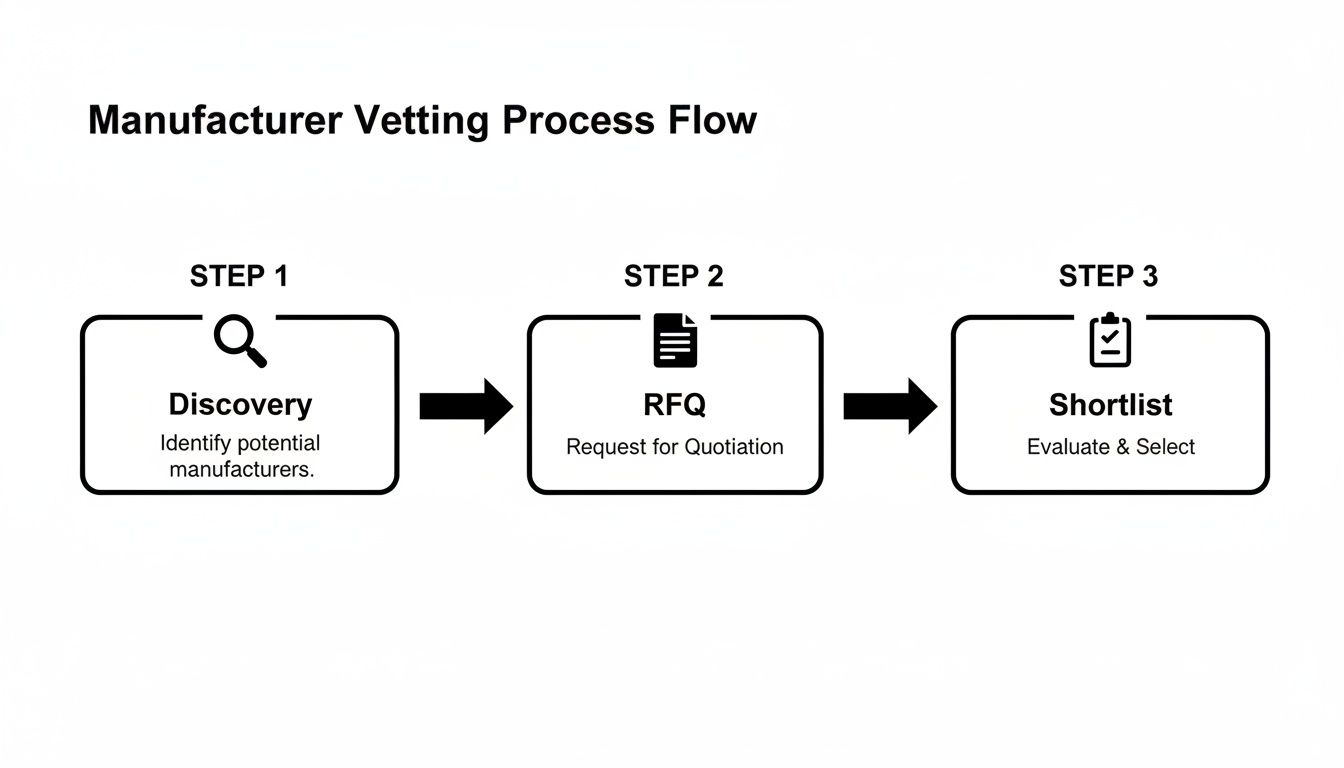
As you can see, shortlisting partners is just the beginning. The real test comes when you get your hands on that first sample.
Providing Feedback That Gets Results
Vague feedback like "it doesn't look right" is a recipe for disaster. I’ve seen it lead to endless, frustrating revisions that waste time and money. Your feedback needs to be surgical.
Get visual. Take photos and videos. Mark up images with arrows and specific notes. Instead of saying "the sleeve is too long," say "reduce sleeve length by 1.5 inches from the cuff." Always reference your original tech pack measurements—it keeps everyone accountable. This kind of precision leaves zero room for misinterpretation and shows you know what you're doing.
If you really want to get this right, especially with complex garments, check out our ultimate guide to quick denim sample production.
Key Takeaway: Treat every piece of feedback as a binding instruction. Clear, measurable comments (e.g., "move pocket placement 0.5 inches to the left") are infinitely more effective than subjective opinions.
Understanding Timelines and Costs
So, what should you actually expect? A first proto sample can take anywhere from 3 to 10 days, depending on how complex your design is and how busy the factory is. Remember, each round of revisions adds to this timeline, which is another reason why clear, precise feedback is your best friend.
As for cost, most manufacturers will charge for samples, often at 1.5x to 3x the final production cost per unit. This just covers the focused labor and materials for making a single piece.
But here’s a pro tip: a good low MOQ clothing manufacturer will often credit these sample fees back to you once you place the bulk production order. This is a great sign you've found a partner who is invested in a long-term relationship, not just a one-off job. Always, always clarify this policy upfront to avoid any surprises down the line.
Understanding Production Costs and Negotiation
Profit in fashion doesn’t just come from a killer design; it’s born from knowing your numbers inside and out. When you first get a quote from a low MOQ clothing manufacturer, the mix of acronyms and line items can feel like a different language. But learning how to read it is your first real step toward protecting your margins.
The per-unit price is never just one number. A manufacturer's quote is really a puzzle made of several key pieces. You'll hear terms like Cost of Materials (COM) and Cut, Make, Trim (CMT) thrown around a lot.
COM is what it sounds like—the cost of your fabric, buttons, zippers, thread, and anything else that physically makes up the garment. CMT, on the other hand, covers all the labor: cutting the patterns, sewing everything together, and adding those final trims. Seeing this split shows you exactly where your money is going.
Decoding the Anatomy of a Quote
When a quote lands in your inbox, fight the urge to just scan for the final number at the bottom. A good manufacturing partner will give you a transparent breakdown. If they don't, that’s a red flag. A detailed quote is your best tool for spotting hidden fees and asking smart questions.
Here’s what you should be looking for beyond just COM and CMT:
- Grading Costs: This is the one-time fee to scale your base pattern into all the different sizes you plan to offer (S, M, L, XL).
- Finishing and Treatment Fees: Think custom washes, screen printing, or embroidery. These add to the per-unit cost and should always be listed separately.
- Packaging and Labeling: Don't ever assume things like hang tags, poly bags, and care labels are included. They’re usually a separate line item.
Getting this level of detail is the only way to accurately calculate your landed cost—the true total it costs to get that product from the factory floor into your warehouse. For a much deeper dive on this, our article on how to balance quality and cost in denim manufacturing is a fantastic resource.
The rise of flexible production partners has been a game-changer. Low MOQ clothing manufacturers dropped minimums to just 25-50 pieces per design, a world away from the old standard of 300+. This shift has opened the door for new brands to align with conscious consumers—like the 68% of Gen Z shoppers who prioritize ethical sourcing, fueling an 11% CAGR in the slow fashion market. Discover more insights about this shift on mmsclothing.com. This is precisely why partners who can produce high-quality denim from just 30 units are so vital for today's brands.
Negotiation Beyond the Per-Unit Price
Now, let's talk about negotiation. With small-batch orders, trying to just haggle down the per-unit price is a rookie mistake. A factory's setup costs are mostly fixed, whether they're making 50 pieces or 500, so their margins on small runs are already paper-thin. You need to think bigger.
True negotiation with a low MOQ partner isn't about squeezing their margins. It’s about finding creative ways to share risk and create mutual value that goes beyond a single order.
Instead of focusing on that one number, shift the conversation to terms that help both of you in the long run.
- Payment Terms: Rather than pushing for a lower unit cost, see if you can get more favorable payment terms. A 50% upfront, 50% upon shipment split is a common, fair arrangement that can seriously help your cash flow.
- Shared Fabric Inventory: This is a powerful but often overlooked strategy. Ask if the manufacturer can buy and hold a larger quantity of your chosen fabric. They get a better price from the mill, and you get to place faster, smaller re-orders without waiting weeks for new materials to arrive. It's a win-win.
- Tiered Pricing Structures: Frame your first small order as a test run. Come to the table with a plan. Discuss a tiered pricing model where your per-unit cost automatically decreases as your order volume grows. This shows them you’re serious about scaling and gives them a reason to invest in your success.
When you approach the conversation this way, it stops being an adversarial haggle and becomes a strategic partnership. You prove you're thinking about a long-term relationship, which is exactly what the best low MOQ clothing manufacturers are looking for.
Managing Quality Control and Logistics From Afar
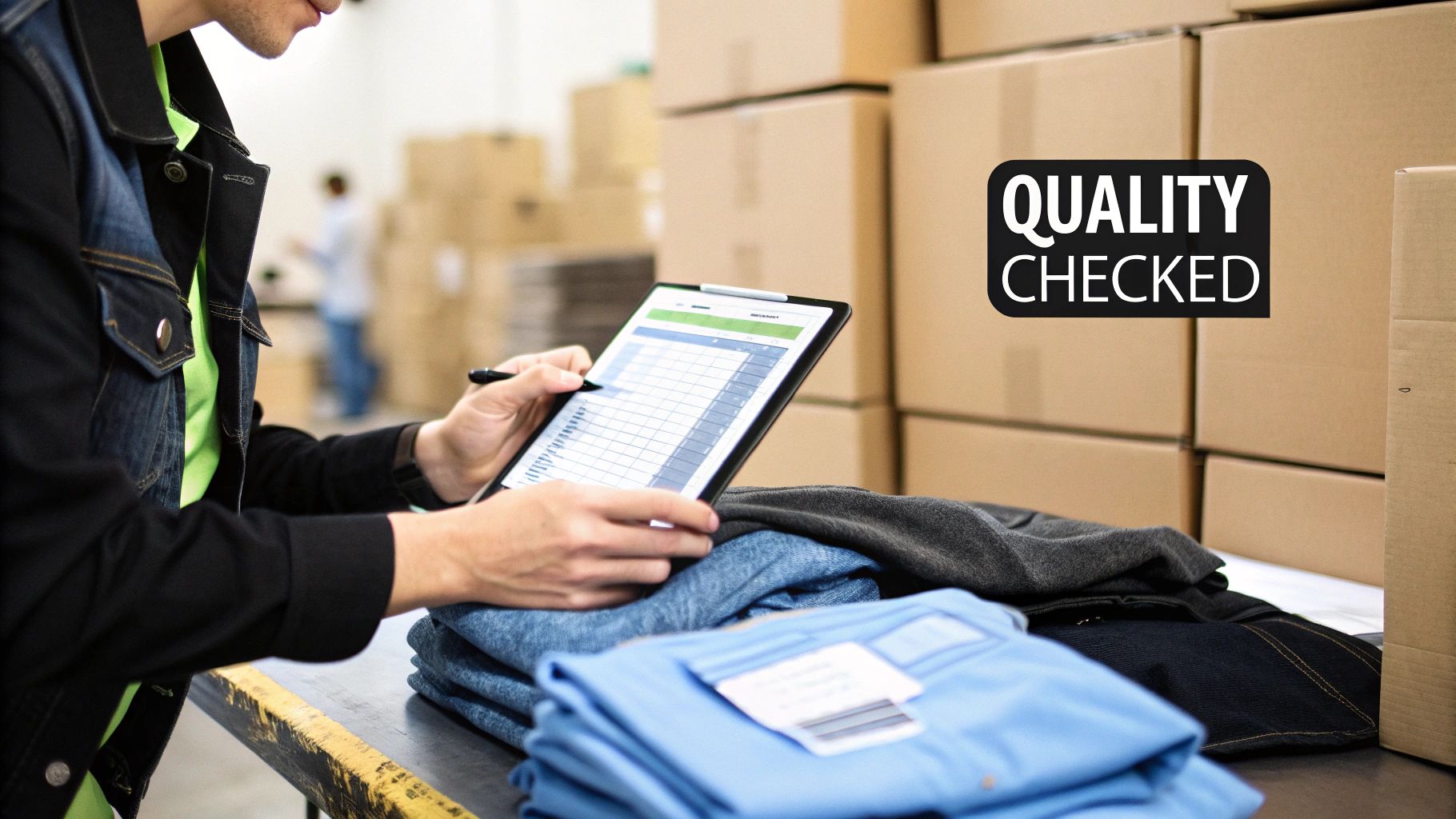
Alright, your pre-production sample is perfect and the factory is about to start the run. This is where your role pivots from creative director to operations manager. It can feel a bit nerve-wracking to oversee quality and shipping from thousands of miles away, but it’s totally manageable with the right systems in place.
Your focus now boils down to two things: making sure every piece is flawless and getting the finished product to your warehouse on time. This isn’t about micromanaging your factory. It’s about setting crystal-clear expectations and using proven industry standards to hold your partner accountable. Any great low MOQ clothing manufacturer will already have these processes baked into their workflow.
Putting a Real QC System in Place
A proactive quality control (QC) plan is your best insurance policy against expensive mistakes. Trust me, the last thing you want is to wait until an entire order is finished and boxed up to start checking for problems. You have to catch issues early on when they’re still easy and cheap to fix.
This is where the Acceptable Quality Limit (AQL) becomes your best friend. AQL is a statistical method used across manufacturing to decide the maximum number of defective units that can be considered “acceptable” in a random sample. Before production even kicks off, you and your factory agree on an AQL standard. For apparel, AQL 2.5 is a common and solid benchmark. It takes all the guesswork out of the equation and gives both of you a clear, measurable definition of what "good enough" actually means.
To make this work in the real world, your QC process needs two key checkpoints:
- In-Line Inspections: These happen while your clothes are being made. An inspector—either from the factory or a third-party service—pulls a sample of garments right off the line. This is fantastic for catching widespread problems, like a sewing machine that’s been calibrated incorrectly, before it affects hundreds of pieces.
- Final Inspections: This is your last line of defense before the goods are packed for shipping. A random sample is pulled from the completed order and checked against your AQL standard for any defects in measurements, stitching, fabric, or finishing.
Don't think of quality control as you versus the factory. It’s a team effort to protect your brand’s reputation. A good manufacturing partner will send you real-time QC reports with photos, giving you the transparency you need to sleep at night.
Nailing International Logistics
Once your order gets the green light from the final inspection, the last hurdle is getting it home. International shipping is swimming in acronyms, but for your purposes, you really only need to get a handle on two key Incoterms (International Commercial Terms).
- EXW (Ex Works): With this term, the product becomes your problem the second it leaves the factory floor. You're on the hook for arranging and paying for everything—from truck pickup at the factory to ocean freight, customs, and final delivery. It offers total control but also comes with total responsibility.
- FOB (Free on Board): This is far more common and usually much easier for new brands. The manufacturer handles getting the goods to the designated port and clearing them for export. Your responsibility (and cost) starts the moment the boxes are loaded onto the ship or plane.
Your choice between EXW and FOB really depends on your experience and who you're working with for freight. A good freight forwarder can manage the whole process no matter what, but an FOB arrangement definitely simplifies those initial steps.
The global apparel market is bouncing back, and agile factories are at the heart of it. In a 2025 survey, brands were singing the praises of Portuguese manufacturers for hitting activewear MOQs of just 30-50 pieces, right on par with what many Chinese factories offer for hoodies. This blend of small-batch agility and mass-production capability is a game-changer for DTC brands. You can discover more insights on trusted low MOQ manufacturers from athleisurebasics.com.
No matter which term you agree on, be ready for customs clearance. Your freight forwarder will handle the paperwork, but make sure your product descriptions and valuations are spot-on to avoid any hold-ups. Thankfully, more and more manufacturers are offering digital tracking portals, giving you full visibility from their door to yours and turning a once-opaque process into just another part of your supply chain.
Common Questions About Low-MOQ Manufacturing
Jumping into apparel production brings up a ton of questions, especially when you’re trying to keep order sizes small and risks low. As a founder, getting straight answers is the only way to move forward with any real confidence.
Here are the most common questions I hear from designers and entrepreneurs who are looking for the right low-moq clothing manufacturer. These are the practical, real-world issues you'll face around cost, quality, and communication, and getting them right from the start makes all the difference.
What Is a Good Low MOQ for Clothing?
Honestly, there's no single magic number for a "low MOQ." It's more of a spectrum that shifts based on how complex your designs are.
For most apparel, a good benchmark is anywhere between 30 and 300 units per style. That’s a huge departure from the old days when factories wouldn't even talk to you for less than 1,000 pieces.
If you’re making something simple like t-shirts or basic hoodies, you can often find partners happy to start with just 50 units. But for more involved garments—think custom-washed denim or pieces with heavy embroidery—a starting point closer to 100 units is far more realistic. Either way, the advantage is clear: you get to test new ideas in the market without betting the entire farm on one design.
Is Low-MOQ Production More Expensive Per Item?
Yep, it almost always is. But before you panic, understand that you're not getting ripped off; it's just the economics of manufacturing.
Every production run has fixed setup costs, from creating patterns and grading sizes to calibrating machinery and sourcing materials. When you spread those costs across just 50 garments instead of 1,000, the price per piece naturally goes up.
Thinking of this as just a higher expense is the wrong mindset. It's a strategic investment in de-risking your business.
Think of the higher per-unit cost not as an expense, but as an insurance policy. You're paying a small premium to protect your capital from the catastrophic risk of a failed product launch and thousands in dead stock.
By starting small, you keep your cash flexible and avoid the nightmare of being stuck with a style that doesn't sell. A successful small run validates your design, giving you the hard data and confidence to place a much larger, more cost-effective reorder.
What Should My First Email to a Manufacturer Include?
Your first impression is everything. Vague, one-line emails like "How much for clothes?" are a fast track to being ignored. A concise but detailed first message signals you’re a serious professional and gets you a much faster, more accurate response. It shows you’ve done your homework and respect their time.
Here's what your initial email should always cover:
- A Quick Intro: Who are you? What's your brand about? Just a sentence or two will do.
- Clear Design Files: At a minimum, attach sketches. Ideally, you should send a complete tech pack for each design. This is non-negotiable for an accurate quote.
- Key Garment Details: Specify the fabric, colorways, and any special treatments you need, like printing or custom washes.
- Your Order Quantity: Be specific. Instead of "a small order," say "a test run of 75 units per style across three sizes."
- Your Target Timeline: When do you need the goods? This helps them see if your launch fits into their production schedule.
This level of detail helps a manufacturer immediately know if they’re a good fit and gives them everything they need to send back a meaningful preliminary quote.
How Do I Ensure Quality With an Overseas Manufacturer?
Getting top-notch quality has nothing to do with geography and everything to do with your process. You can absolutely get incredible products made overseas if you're diligent and systematic. It all boils down to solid vetting, meticulous sampling, and crystal-clear standards.
First, your vetting has to be airtight. Ask for their certifications (like OEKO-TEX® or GOTS for sustainable fabrics) and request examples of similar work they've done. A factory that does great work is always proud to show it off.
Second, never, ever skip sampling. This is your single most important quality checkpoint. You must get a final, perfect pre-production sample in your hands and approve it before they start making a single piece of your bulk order.
Finally, set your quality expectations in writing from day one. Create a detailed QC checklist and agree on an AQL (Acceptable Quality Limit) standard—AQL 2.5 is a common benchmark for apparel. For your first few runs, it’s also a smart move to hire a third-party inspection service to check the goods on-site before they ship. This gives you an unbiased report and ensures your standards are met before you pay that final invoice.
Ready to bring your vision to life without the risk of high minimums? SkyKingdom Group is the premier partner for DTC brands and independent designers who need speed, quality, and flexibility. Our hybrid production model supports small-batch trials from just 30 units and scales with you to 30,000 pieces. With 3-5 day sampling and 15-22 day bulk production, we help you hit trend windows with confidence. Start building your collection with SkyKingdom Group today.
Written with Outrank