
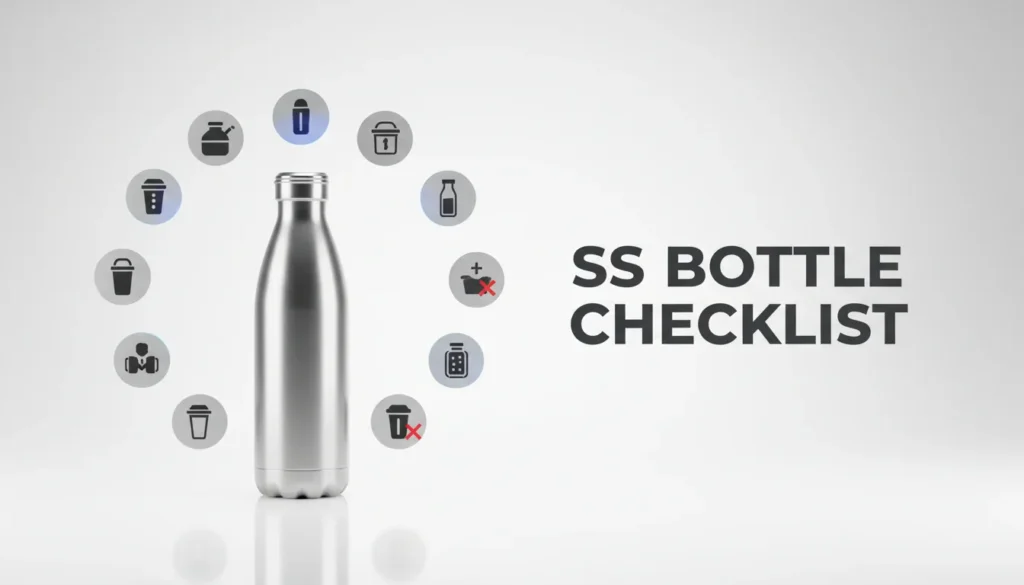
You’re standing in the drinkware aisle (or scrolling at midnight), and every ss water bottle promises “leakproof,” “cold for 24 hours,” and “premium steel.” I’ve tested bottles that truly deliver—and others that look great until they rattle, sweat, or make water taste “metallic” by day three. So let’s make this simple: here’s the checklist I use to separate real performance from marketing fluff. Which features are worth paying for, and which ones you can skip?

The 15-feature SS water bottle checklist (with “Worth it” or “Skip it”)
1) 18/8 (304) stainless steel — Worth it
For an everyday ss water bottle, 18/8 stainless (often called food-grade) is the baseline for durability and corrosion resistance. It’s also a common standard across premium bottle makers, which makes comparisons easier. If a listing doesn’t clearly state the steel grade, that’s a buying risk.
- Look for: “18/8,” “304 stainless,” or “food-grade stainless”
- Avoid: vague “stainless steel” with no grade
2) Double-wall vacuum insulation — Worth it (if you want cold/hot retention)
Vacuum insulation is what keeps ice lasting and coffee warm—and it’s also what prevents sweaty condensation on the outside. Brands like Stanley explain the principle clearly: remove the air between walls to reduce heat transfer. If you want all-day temperature control, this is the feature.
- Best for: commuting, travel, outdoor days
- If you mostly drink room-temp water: you may not need it
3) A ceramic-coated interior (taste protection) — Worth it for picky palates
I’ve tried bottles that kept water cold but left a faint “metal” note—especially after citrus or flavored mixes. A ceramic-lined interior can reduce taste transfer and help keep flavors cleaner, which is a signature approach some premium lifestyle brands lean into. If taste is a dealbreaker, prioritize this.
- Great for: lemon water, iced tea, electrolytes
- Tradeoff: can add cost
4) True leakproof lid design (with a real gasket) — Worth it
“Leak-resistant” is not the same as leakproof. A dependable ss water bottle lid uses a well-seated silicone gasket and secure threading or a locking mechanism. If you toss it into a work bag, this is non-negotiable.
- Check for: replaceable gasket, locking spout, positive click/close
- Quick test: fill, tighten, invert for 10 seconds
5) Wide mouth vs. narrow mouth (choose based on your routine) — Worth it
This is a usability feature more than a “spec.” Wide-mouth bottles are easier to clean, fit ice cubes, and accept many filters. Narrow-mouth bottles can be nicer for spill-free sipping while walking.
- Wide mouth: cleaning + ice + versatility
- Narrow mouth: controlled drinking, less slosh
To match style to use, skim What Are the Different Types of Water Bottles?.
6) Cup-holder compatibility — Worth it if you drive
If it lives in your car, diameter matters. Many people buy a 32–40 oz bottle and then hate it because it never fits the console. If you commute, measure your cup holder before you commit.
- Ideal base diameter: often ~2.8″–3.2″ (varies by vehicle)
- Hack: bottles with a “tapered base” tend to fit more cars
7) Powder coat (grip + scratch resistance) — Worth it
A quality powder coat helps with grip, hides fingerprints, and resists minor scratches. It also makes a big bottle easier to hold when your hands are sweaty (gym, summer, hiking). Not all coatings are equal—cheap ones chip early.
- Check for: even texture, no thin spots around edges
8) Non-slip silicone base — Worth it in real life
This is one of those features you don’t appreciate until you work in a quiet office or set your bottle down during a meeting. A silicone base reduces clanks, stops sliding, and helps protect surfaces. It’s a small detail that signals thoughtful design.
9) Straw lid vs. chug cap (pick one; don’t overpay for both) — Depends
Straws help you sip more without tilting (great for desks and driving). Chug caps are simpler and often easier to deep-clean. If you’re buying one bottle, choose the lid you’ll actually use daily.
- Straw lid: higher hydration compliance for many people
- Chug cap: fewer parts, less odor risk
For training days, Choosing the Best Water Bottle for Your Gym Routine breaks down practical fit and function.
10) Dishwasher-safe claim — Worth it only if it’s specific
Many insulated bottles last longer with hand-washing, especially lids and painted finishes. “Dishwasher safe” should specify what is safe (bottle? lid? both?) and which rack. If it’s vague, assume you’ll hand-wash the lid at minimum.
- Best practice: hand-wash lid + gasket; occasional deep clean
If you want a straightforward method, use this guide: How to Clean Reusable Water Bottles.
| Feature | Why it matters | Who should prioritize it | “Worth it” or “Skip” |
|---|---|---|---|
| 18/8 stainless steel | Resists rust, dents, and flavor transfer; durable long-term | Daily users, travelers, anyone keeping bottles for years | Worth it |
| Vacuum insulation (double-wall) | Keeps drinks cold/hot for hours; prevents exterior sweating | Commuters, gym users, outdoor/hiking, hot/cold beverage drinkers | Worth it |
| Ceramic interior lining | Reduces metallic taste; better for coffee/tea; can stain/chip if abused | Coffee/tea drinkers, taste-sensitive users | Worth it (if taste-sensitive) |
| Leakproof gasketed lid | Prevents bag leaks; improves reliability over time with replaceable seals | Students, office commuters, parents, anyone tossing it in a backpack | Worth it |
| Wide mouth opening | Easier ice fill and cleaning; can be splashy for sipping | Ice users, easy-clean priority, bottle-brush users | Worth it |
| Cup-holder fit (narrow base) | Practical for driving/commuting; avoids wobble/spills in cars | Drivers, rideshare, long commutes | Worth it (if driving often) |
| Powder coat exterior | Better grip; hides scratches; can improve durability | Gym users, outdoors, anyone who drops/handles with sweaty hands | Worth it |
| Silicone base/boot | Reduces noise; protects surfaces and bottle; adds a bit of bulk | Office/desk users, clumsy droppers, homeowners protecting counters | Worth it (optional) |
| Straw vs chug lid option | Straw = easier one-handed sipping; chug = faster flow/cleaner; impacts cleaning | Straw: desk/driving; Chug: workouts/hikes; hygiene-focused users | Worth it (choose based on use) |
| Dishwasher-safe specifics (bottle, lid, gasket) | Saves time; some lids/gaskets degrade; hand-wash may extend seal life | Busy households, shared bottles, anyone who values low maintenance | Worth it (verify lid & gasket safe) |
11) BPA-free (for the lid/straw parts) — Worth it (but baseline)
Stainless steel is the body; plastics usually show up in lids, spouts, and straws. “BPA-free” is now common, but you still want it explicitly stated—especially if the bottle is budget-priced or the listing is unclear.
- Also look for: food-grade silicone for gaskets
12) Minimal seams and an easy-to-clean lid — Worth it
Odors usually come from hidden crevices, not the steel. I’ve found that lids with fewer parts and fewer tight corners stay fresher with normal cleaning. If a lid has multiple valves and tiny channels, plan on more maintenance.
- Prioritize: removable gasket, simple geometry, accessible straw
13) Realistic temp claims (not just big numbers) — Worth it
“24 hours cold” can be true—but only under certain conditions (starting temp, ice amount, lid openings, outdoor heat). Reviews from rigorous testers can help validate claims; outlets like Wirecutter also emphasize cleaning and usability alongside performance. Treat temperature promises as a guideline, not a guarantee.
- Tip: if you open the lid often, performance drops fast

14) Ultra-large capacity (40–64 oz) — Skip it unless you’ll carry it
Big bottles can be great at a desk, but they’re heavy, harder to fit in bags, and often fail the cup-holder test. If you truly want a “home base” hydration tank, go big; otherwise, many people stick better with 20–32 oz and refill.
- Reality check: will you carry it full, daily?
15) Trendy add-ons (stickers, novelty shapes, “limited” hype) — Usually skip
Style matters—Corkcicle’s collaborations show how design can make hydration more fun and giftable. But performance should come first: steel grade, insulation, lid seal, and cleanability beat aesthetics. If you’re choosing between looks and a better lid, pick the lid.

Quick “buy this / skip that” summary
If you want a dependable ss water bottle, prioritize these first:
- 18/8 stainless steel
- Leakproof gasketed lid
- Easy-clean lid design
- Vacuum insulation (if you want cold/hot performance)
- Right mouth size + cup-holder fit for your routine
Skip or down-rank these unless they match your lifestyle:
- Oversized capacity you won’t carry
- Vague dishwasher-safe claims
- Hype features that don’t improve sealing, taste, or cleaning
For a clear comparison of materials and why stainless often wins on durability and long-term use, see Stainless Steel vs Plastic vs Glass Water Bottles.
How I personally choose an SS water bottle (a practical 60-second test)
When I’m evaluating a bottle quickly, I do three checks:
- Seal test: fill it, tighten, invert—no drips.
- Lid complexity: if I can’t fully access the gasket and corners, I pass.
- Daily fit: bag pocket, cup holder, and one-hand use all matter more than “max hours cold.”
If you want third-party perspectives on performance and usability, reviews like NYT Wirecutter’s water bottle testing and hands-on roundups such as Serious Eats’ stainless steel water bottle tests can be helpful benchmarks.
Top 5 Best Metal Water Bottles | Vacuum-Insulated, Stainless Steel, Leak Proof | Review 2023
Conclusion: Your SS water bottle should disappear into your day (in a good way)
A great ss water bottle doesn’t demand attention—it just doesn’t leak, doesn’t stink, keeps the right temp, and feels good to carry. That’s the sweet spot Corkcicle’s premium drinkware category aims for: performance details you notice because problems stop happening. If you’re deciding between two bottles, choose the one with the better lid, easier cleaning, and a size you’ll actually use every day.
FAQ: SS water bottle questions people actually search
1) What does “ss water bottle” mean?
It typically means a stainless steel (SS) water bottle, often with vacuum insulation for temperature retention.
2) Is 18/8 stainless steel safe for water bottles?
Yes—18/8 (304) is widely used as food-grade stainless steel due to its corrosion resistance and durability.
3) Do insulated stainless steel bottles keep water cold for 24 hours?
Many can, but results depend on ice, starting temperature, how often you open the lid, and ambient heat.
4) Why does my stainless steel bottle make water taste weird?
Taste can come from residue in the lid/straw, detergent buildup, or flavor carryover. Deep-clean the lid and gasket; some people prefer ceramic-lined interiors for taste neutrality.
5) Are straw lids less hygienic than chug caps?
Not automatically, but straw lids often have more parts and tight channels that require more thorough cleaning.
6) Should I buy a wide-mouth or narrow-mouth SS water bottle?
Wide-mouth is easier to clean and fits ice; narrow-mouth is often easier for spill-controlled drinking on the move.
7) Can I put my stainless steel water bottle in the dishwasher?
Sometimes—check whether the brand specifies bottle vs. lid, rack placement, and whether finishes are dishwasher-safe. When in doubt, hand-wash the lid and gasket.