
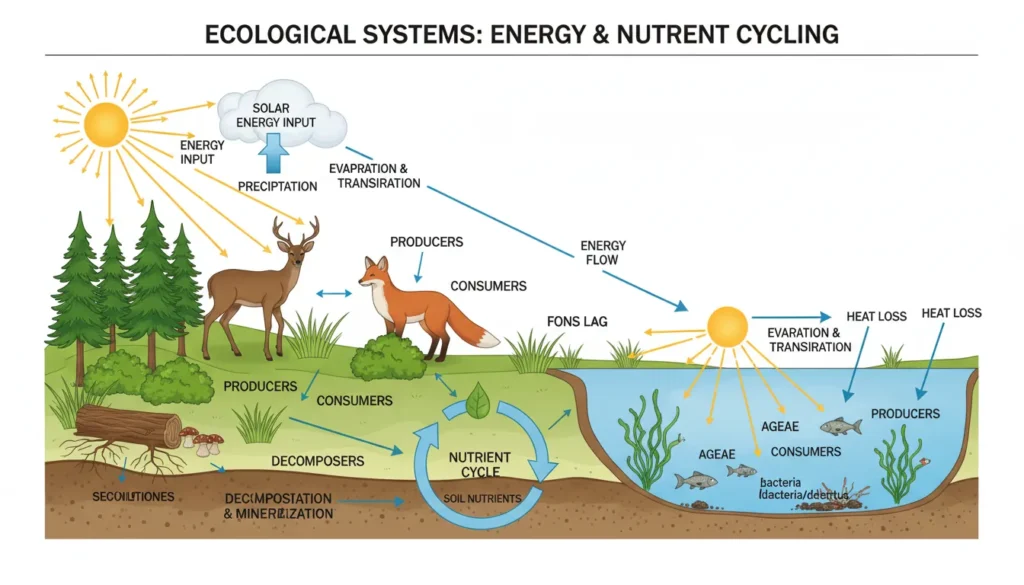
Ecologies are like the “operating system” of the living world: they quietly manage energy, resources, and relationships so forests grow, rivers run clear, and cities (mostly) function. If you’ve ever wondered why removing one species can ripple across an entire landscape—or why some places bounce back after disturbance while others collapse—you’re already thinking in ecologies. In this guide, I’ll break down what ecologies mean, how ecosystems really work, and how to see ecological patterns in everyday life (including the “human-made” ecologies we build around tools, production, and communities).

What “Ecologies” Means (and Why the Plural Matters)
Ecology is the study of relationships between living organisms (including humans) and their physical environment—how life interacts with air, water, soil, climate, and with other life. People often say “ecologies” (plural) to emphasize that there isn’t just one environment or one kind of system. There are many interconnected ecologies: a pond ecology, a soil ecology, an urban ecology, even a “creative ecology” in a maker community.
In practice, “ecologies” highlights three truths:
- Scale changes the story: what’s true for one organism may not be true for a whole ecosystem.
- Context is everything: the same species behaves differently in different habitats.
- Systems overlap: environmental, social, and mental “ecologies” can reinforce—or destabilize—each other (a theme often discussed in frameworks like Guattari’s “three ecologies”).
How Ecosystems Really Work: The 5 Core Mechanics
When I’m teaching ecologies to beginners, I use five “mechanics.” They’re simple enough to remember but powerful enough to explain most real-world outcomes.
1) Energy Flow (Not a Cycle)
Energy typically flows one-way: sunlight → plants → animals → decomposers → heat loss. The key idea: energy is spent at every step, which limits how many trophic levels an ecosystem can support.
- Producers convert sunlight to biomass.
- Consumers move that energy through the food web.
- Decomposers unlock energy and materials from dead matter.
2) Nutrient Cycling (A True Cycle)
Unlike energy, nutrients cycle: carbon, nitrogen, phosphorus, and water move through living things and the environment. Healthy ecologies keep these cycles balanced; disrupted ecologies often leak nutrients (think algal blooms from excess nitrogen).
3) Interactions: Competition, Predation, Mutualism
Ecologies are relationship-driven. A single species rarely “acts alone.”
- Competition: organisms fight over limited resources.
- Predation/Herbivory: controls populations and shapes behavior.
- Mutualism: both benefit (pollinators + flowers, mycorrhizal fungi + roots).
4) Feedback Loops (Stability vs. Runaway Change)
Feedback loops determine whether a system self-corrects or spirals.
- Negative feedback stabilizes (predators increase → prey decrease → predators decrease).
- Positive feedback amplifies change (warming melts ice → less reflection → more warming).
5) Disturbance and Resilience
Fire, floods, droughts, storms, pests, and human activity can all be disturbances. What matters is resilience: can the ecosystem absorb a shock and reorganize without losing its core functions?
I’ve seen this firsthand in restoration work: two sites can look similar on a map, but one rebounds quickly after invasive removal while the other stalls for years. The difference is often soil biology, seed bank health, and water dynamics—the less visible layers of ecologies.
Levels of Ecology: From Organisms to Whole Systems
Ecologies are studied at different levels, each with different questions:
- Organismal ecology: How does a single species survive (temperature, diet, behavior)?
- Population ecology: What controls population size and growth?
- Community ecology: How do species interactions shape who lives where?
- Ecosystem ecology: How do energy and nutrients move through the system?
A common mistake is to use the wrong “lens.” For example, planting one “helpful” species might look good at the organism level, but could harm the community level if it outcompetes natives.
Types of Ecologies You’ll Hear About (Including “Shadow Ecologies”)
Beyond classical ecosystem categories, modern ecology talks about how humans reshape habitats and create byproducts that living systems adapt to.
- Urban ecologies: heat islands, fragmented habitats, novel food sources.
- Industrial ecologies: resource flows, waste streams, circularity opportunities.
- Shadow ecologies: biological communities that rely on human waste products or infrastructure byproducts (e.g., organisms thriving in drainage systems, landfills, or artificial light corridors).
- Creative ecologies: networks of people, tools, skills, and cultural exchange that influence what gets made and how knowledge spreads.
This is where “ecologies” becomes especially useful: it reminds us that systems can be natural, built, or hybrid—and still obey ecological principles.
Four Ecologies (Banham) and Three Ecologies (Guattari): Quick, Practical Context
You may see “ecologies” used outside biology:
- Banham’s four ecologies (often discussed in architecture/urban theory): surfurbia, foothills, the plains of Id, and autopia—a way to read how landscapes, infrastructure, and lifestyles form distinct environmental patterns.
- Guattari’s three ecologies: environmental, social, and mental ecologies—arguing that ecological crises are not only physical but also cultural and psychological.
You don’t need these frameworks to understand ecosystems, but they’re helpful reminders that ecologies include human choices, not just “nature over there.”
A Practical Field Guide: How to “Read” Ecologies in Real Life
When you walk into a park, shoreline, farm, or city block, use this checklist. It turns ecology from abstract theory into observable signals.
Step-by-step observation method
- Identify energy sources
- Sunlight exposure, shade patterns, artificial lighting, heat from pavement.
- Find the limiting resource
- Water? Nitrogen? Shelter? Pollinators? Space? Time (seasonality)?
- Map relationships
- Who eats whom? Who competes? Who helps?
- Look for nutrient movement
- Leaf litter, composting zones, erosion, runoff paths.
- Spot disturbances
- Mowing, foot traffic, storms, construction, invasive species.
- Assess resilience cues
- Diversity, regeneration, soil structure, presence of decomposers.

Ecologies and Making: Why Tool Ecosystems Matter (xTool Example)
In digital fabrication, people often talk about a brand “ecosystem.” That’s not just marketing language—it’s an ecology analogy: tools + materials + workflows + community + safety practices interact like a system. In my own projects, the difference between a frustrating build and a profitable product run often came down to the “supporting species” in the system: reliable settings libraries, dust/smoke management, jigs, and repeatable design pipelines.
For makers and small businesses, an ecosystem approach can look like:
- Hardware that matches materials (CO2 vs diode vs fiber/UV for different substrates)
- Software that reduces setup errors and speeds iteration
- Accessories and safety that prevent downtime (air purification, fire safety practices)
- Community knowledge that spreads tested parameters and fixtures
If you’re exploring fabrication workflows, xTool’s broader ecosystem—machines plus software like xTool Studio and features like AI Make—is a real-world example of building a resilient “creative ecology” around production.
For deeper reading on biological ecology fundamentals, see National Geographic’s ecology overview, Encyclopaedia Britannica’s ecology entry, and the U.S. EPA page on ecosystems.
Key Ecology Concepts, Compared (So You Don’t Mix Them Up)
| Concept | What it Means in Ecologies | Simple Example | Common Mistake |
|---|---|---|---|
| Food chain | Linear energy transfer | grass → rabbit → fox | Assuming it’s the whole story |
| Food web | Network of feeding links | fox also eats mice; rabbits eat many plants | Ignoring indirect effects |
| Keystone species | Disproportionate influence | sea otters control urchins, help kelp forests | Thinking “biggest” = keystone |
| Trophic cascade | Ripple effects across levels | fewer predators → more herbivores → less vegetation | Treating it as guaranteed everywhere |
| Carrying capacity | Max sustainable population | deer limited by winter food | Assuming it’s fixed forever |
| Succession | Community change over time | field → shrubs → forest | Believing it’s always linear |
Common Myths About Ecologies (and What’s Actually True)
-
Myth: “Nature is balanced.”
Reality: ecologies are dynamic; stability is often a moving target shaped by disturbance. -
Myth: “More predators always means fewer problems.”
Reality: it depends on habitat, prey alternatives, and human constraints (roads, fragmentation). -
Myth: “If you plant trees, you’ve restored the ecosystem.”
Reality: without soil health, water function, and native diversity, you may create a weak system. -
Myth: “Human systems aren’t ecological.”
Reality: cities and industries still follow resource limits, feedback loops, and resilience rules.

Ecology Review: Food Chains & Webs, Relationships, Nitrogen & Carbon Cycles, Effects on Biodiversity
Conclusion: Ecologies Are the Story of Connection—And You’re In It
Ecologies aren’t just about “wild places.” They’re the rules of connection—energy, nutrients, relationships, feedback loops—that shape forests, farms, and the systems we build at home and work. When you start noticing limiting resources, hidden decomposers, and the feedback loops behind everyday changes, ecosystems stop feeling mysterious and start feeling readable. If you’re building products, communities, or workflows, thinking in ecologies helps you design for resilience instead of constant repair.
FAQ: Ecologies (People Also Ask)
1) What is the meaning of ecologies?
Ecologies refers to the study (and the real-world presence) of relationships between organisms and their environment. The plural often emphasizes multiple, overlapping systems across scales and contexts.
2) What are the different types of ecologies?
Common types include organismal, population, community, and ecosystem ecology. In applied settings you’ll also hear urban ecology, industrial ecology, and “shadow ecologies” shaped by human infrastructure and waste.
3) What are the three ecologies explained?
A well-known framework (Guattari) links environmental, social, and mental ecologies, arguing they interact and should be addressed together rather than separately.
4) What are the four ecologies?
In architecture/urban theory, Banham described four “ecologies” of Los Angeles—surfurbia, foothills, the plains of Id, and autopia—to explain how landscape and infrastructure shape city life.
5) What is a food web vs. a food chain?
A food chain is a linear path of energy transfer; a food web is a network of many feeding relationships. Most real ecologies behave like webs, not chains.
6) What are shadow ecologies?
Shadow ecologies are biological communities that depend directly on human byproducts—waste, altered habitats, heat, light, or infrastructure—rather than “pristine” natural conditions.
7) Can you play Ecologies by yourself?
Yes. “Ecologies” is also the name of a card game used for learning ecology concepts, and it includes a solo mode where you try to beat your own score.