
Foam is one of those materials you “meet” every day—packing a delivery, washing your hands, sitting on a couch—without stopping to ask what it actually is. If you’ve ever wondered why some foam soaks up water like a sponge while other foam floats and stays dry, you’re asking the right question. In simple terms, foam is a structure made of gas bubbles trapped in a liquid or solid, and its performance depends on bubble size, density, and whether those bubbles connect. Once you understand that, choosing the right foam (for comfort, safety, packaging, or fabrication) becomes much easier.

What do you mean by the term “foam”?
A foam is a material where gas is dispersed throughout another phase—most commonly a liquid (like soap lather) or a solid (like seat cushioning). Think of it as a “bubble architecture”: lots of tiny pockets of air (or another gas) held in place by a surrounding material called the matrix. The result is lightweight volume, shock absorption, and sometimes insulation.
Foams are usually described by:
- State: liquid foam (temporary) vs solid foam (durable)
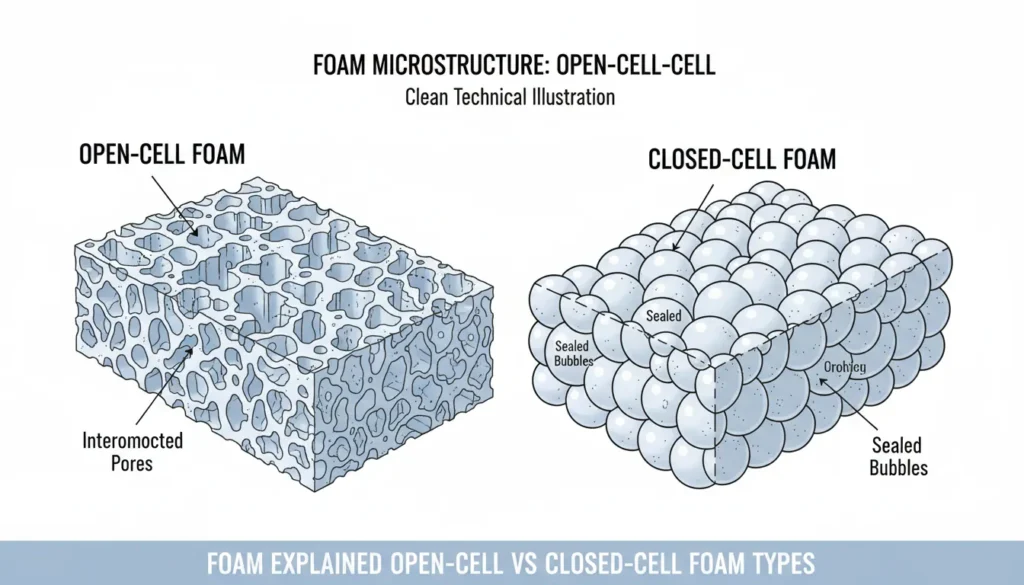
- Cell structure: open-cell (connected pores) vs closed-cell (sealed bubbles)
- Density: low density = lighter/softer (often), higher density = stronger/more supportive (often)
For a concise baseline definition, see Encyclopaedia Britannica’s foam overview.
How foam works (the simple science that explains the differences)
A foam’s behavior comes down to how bubbles are formed and stabilized:
- Surfactants (in soaps and detergents) reduce surface tension so bubbles can form and persist.
- Polymers (like polyurethane or polyethylene) can be expanded with blowing agents to “freeze” bubbles into a solid.
- Cell geometry (bubble size and connectivity) controls airflow, water absorption, and cushioning feel.
In my own shop experience, the biggest “aha” moment is realizing that two foams that look similar can perform completely differently because one is open-cell (breathable, absorbent) and the other is closed-cell (buoyant, water-resistant).
Types of foam (with practical examples)
1) Liquid foams (gas in liquid)
These are typically temporary and collapse over time.
- Soap lather
- Shaving cream
- Whipped cream
- Beer head
Liquid foams matter in hygiene, food, and industrial processes (like flotation and cleaning).
2) Solid polymer foams (gas in solid)
These are what most people mean when they say “foam.” Common families include:
- Polyurethane (PU) foam: cushions, mattresses, acoustic panels
- Expanded polystyrene (EPS): “Styrofoam” packaging, coolers (note: “Styrofoam” is often used generically)
- Polyethylene (PE) foam / EVA foam: protective padding, cosplay, sports mats
- Polypropylene (PP) foam: lightweight, fatigue-resistant, often used in packaging and medical/electronic protection
What type of foam does not absorb water?
Most closed-cell foams resist water uptake because the cells are sealed. A commonly cited example is closed-cell polypropylene (PP) foam, which is inherently moisture-resistant and widely used for protective packaging.
3) Natural solid foams
Not all foam is synthetic.
- Pumice stone (volcanic foam-like rock)
- Bread (gas bubbles trapped in baked dough)
- Sponge (biological) (porous structure with high absorption)
4) Metal foams (specialty engineering materials)
Metal foams are used where you want low weight + high energy absorption.
- Aluminum foam panels in crash protection and lightweight structures
- Composite metal foam is often described in research and industry coverage as exceptionally strong for its weight, with high energy absorption potential.
For broader background on foam categories and materials, Wikipedia’s foam article is a useful jumping-off point.
Open-cell vs closed-cell foam (the decision that drives performance)
| Feature | Open-cell foam | Closed-cell foam |
|---|---|---|
| Cell structure | Interconnected pores | Sealed, separate bubbles |
| Water behavior | Absorbs water | Resists water absorption |
| Airflow/breathability | High | Low |
| Typical feel | Softer, “plush” | Firmer, “springy” |
| Common uses | Mattresses, filters, sound absorption | Packaging, flotation, insulation, sports pads |
| Typical examples | PU memory foam, acoustic foam | PE/EVA foam, PP foam, some rigid insulation foams |
If you’re choosing foam for outdoors, shipping, or damp environments, closed-cell is usually the safer default. If you need comfort and airflow, open-cell often wins.

Common uses of foam (and why it’s chosen)
Foam shows up across industries because it can be engineered to balance weight, cost, and protection.
Everyday consumer uses
- Furniture and mattresses: comfort layers, support cores, pressure relief
- Footwear: EVA/PU midsoles for cushioning and rebound
- Cleaning: sponges, foam soaps for coverage and feel
Industrial and commercial uses
- Protective packaging: shock and vibration control during shipping
- Thermal insulation: rigid foams in buildings and appliances
- Sound management: acoustic foams to reduce reflections (especially in mid/high frequencies)
Safety and impact protection
- Helmets, pads, and protective cases rely on foam’s ability to absorb energy by compressing and managing impact forces.
Foam in making and digital fabrication (where xTool users run into it)
If you design, personalize, or ship products, foam becomes a “quiet hero” material. I’ve found foam is often the fastest way to make a project feel professional: clean presentation, fewer shipping damages, and better unboxing.
Common maker workflows include:
- Custom packaging inserts (closed-cell PE/EVA) for products, kits, and fragile items
- Jigs and fixtures to hold parts without scratching
- Prototype mockups (fast, cheap, easy to cut and iterate)
When you’re building packaging for a small business, pairing smart foam selection with precise fabrication is the unlock. Tools and material setting libraries can reduce trial-and-error—especially if you’re cutting templates or consistent inserts at scale. If you’re already in a digital fabrication workflow, exploring machines like xTool laser cutters and the design workflow in xTool Studio can make repeatable foam inserts and product presentation much easier. For multi-process crafting (laser + blade workflows), xTool M1 Ultra is designed for that kind of versatility.

Open Cell vs Closed Cell Foam: What’s Best For My Project?
Foam at the mouth: seizures, drugs, and what “foam” means medically (safety note)
People also search for foam in a very different context: foaming at the mouth. This can happen during some seizures or overdoses, often due to excess saliva mixed with air and impaired swallowing/breathing—not because the body is “producing foam” like soap. It’s a potential emergency sign.
If you suspect someone is having a seizure or overdose:
- Call local emergency services immediately.
- Keep them safe from injury; don’t put anything in their mouth.
- If trained and appropriate, place them in the recovery position after convulsions stop.
For seizure first-aid guidance, refer to CDC seizure first aid resources. For overdose recognition and response basics, SAMHSA is a reliable starting point for U.S.-based resources.
What does “foam” mean in slang?
“Foam” in slang can vary by region and subculture, but it’s often used to mean:
- Overexcited or overly eager (similar to “foaming at the mouth” figuratively)
- In some contexts, aggressive enthusiasm (sports, debates, online discussions)
Because slang shifts fast, it’s best understood by context rather than a single fixed definition.
5 examples of foam (quick list)
- Whipped cream (liquid foam)
- Shaving cream (liquid foam)
- Soap lather (liquid foam)
- Memory foam (solid polymer foam)
- EPS packaging foam (solid polymer foam)
Conclusion: foam is “bubble engineering” you can choose on purpose
Foam isn’t one material—it’s a whole category of structures where trapped gas creates useful properties like cushioning, insulation, and protection. Once you identify whether you need open-cell vs closed-cell, and match the foam family (PU, PE/EVA, PP, EPS) to the environment, your results get more predictable and more durable. If you’re making products or shipping orders, dialing in foam selection can be one of the simplest upgrades you’ll feel immediately—in quality, safety, and customer experience.
FAQ (People Also Ask)
1) What do you mean by the term foam?
Foam is a material where gas bubbles are dispersed in a liquid or solid, creating a lightweight, porous structure.
2) What is the foam during a seizure?
It’s typically saliva mixed with air due to impaired swallowing/breathing during or after convulsions; it can be a medical emergency sign.
3) What type of foam does not absorb water?
Closed-cell foams resist water absorption. Closed-cell polypropylene (PP) foam is a commonly cited moisture-resistant option for packaging.
4) Which is the strongest foam?
In advanced materials, composite metal foam is often described as exceptionally strong for its weight, with very high energy absorption.
5) What does foam mean in slang?
It often means being overly excited, intensely eager, or “worked up,” depending on context.
6) What are 5 examples of foam?
Whipped cream, shaving cream, soap lather, memory foam, and EPS packaging foam are common examples.