
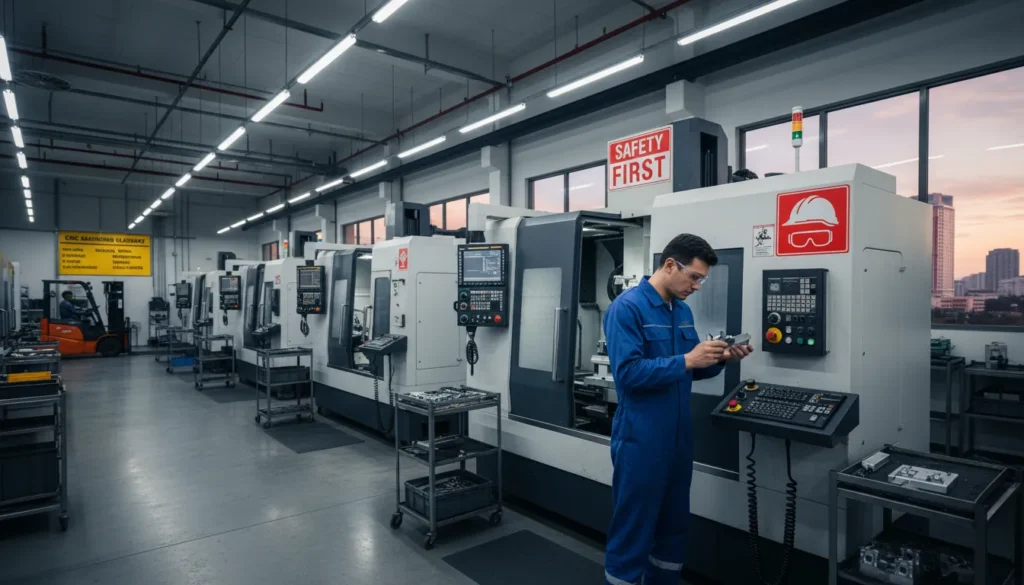
A machine shop can feel like a different language the first time you walk in: people talk in thousandths, quote “setup + cycle,” and toss around terms like tolerance and surface finish like everyone grew up speaking “machinist.” I still remember my first RFQ review where I assumed “±0.001” was “close enough” and learned—fast—that it can be the difference between a part that fits and a part that becomes scrap. This guide explains what machine shops do, the key terms you’ll hear, and how common processes work so you can communicate clearly, price accurately, and get better parts.

What a machine shop does (in plain English)
A machine shop makes parts by removing material (machining) or shaping it with controlled processes to meet a drawing or a functional requirement. Most shops produce components for automotive, industrial equipment, medical devices, aerospace, robotics, and product prototypes. The work usually starts with a CAD model or drawing and ends with inspected parts, documented measurements, and sometimes assemblies.
Typical outputs include:
- One-off prototypes for testing fit and function
- Low-to-mid volume production runs
- Repair work (shaft rework, bushing replacement, thread restoration)
- Fixtures, jigs, and tooling used to make other products
Core machine shop processes (quick overview)
Machine shops often mix several processes to hit cost, speed, and tolerance targets. Here are the big ones you’ll see on quotes and travelers.
CNC milling
Milling uses rotating cutters to remove material while the workpiece is clamped. CNC mills are great for flat faces, pockets, slots, and complex 3D surfaces. Common variants include 3-axis, 4-axis, and 5-axis machining depending on how many directions the tool and part can move.
CNC turning (lathe work)
Turning spins the workpiece while a stationary tool removes material. Lathes excel at round parts like shafts, bushings, threaded components, and concentric features. Many modern machines are mill-turns that can do both operations in one setup.
Drilling, reaming, tapping
Holes are a huge part of machining, and the method matters:
- Drilling creates a hole quickly but not super accurately
- Reaming refines a hole to a precise diameter and finish
- Tapping cuts internal threads (or forms them with a thread former)
Grinding
Grinding uses abrasive wheels to achieve tight tolerances and fine surface finishes—often after heat treat. It’s common for bearing fits, hardened tooling, and critical flatness requirements.
EDM (Electrical Discharge Machining)
EDM removes material using electrical sparks, ideal for hard metals and delicate internal shapes:
- Wire EDM: precise profiles and tight corners
- Sinker EDM: cavities (like mold details)
Measuring the Perfect Surface Finish
Machine shop glossary: key terms you’ll actually use
Below are the terms that most often drive cost, lead time, and whether a shop can hit your requirements.
Tolerance
Tolerance is the allowed variation from a nominal dimension (example: 10.00 mm ±0.02). Tight tolerances increase inspection time, scrap risk, and often require better machines, tooling, and temperature control. If you don’t need it, don’t specify it.
Surface finish (Ra)
Surface finish describes how smooth a surface is, commonly measured as Ra. A finer finish can reduce friction or improve sealing, but it may require slower feeds, different tools, or secondary processes.
GD&T (Geometric Dimensioning & Tolerancing)
GD&T controls geometry beyond size—things like flatness, perpendicularity, position, concentricity. It’s powerful, but it can be misunderstood; clear datum structure and realistic callouts are essential.
Setup time vs cycle time
- Setup time: fixturing, tool changes, programming, proving out
- Cycle time: the machine time per part once running
For small quantities, setup dominates cost. For large quantities, cycle time dominates.
Workholding / fixturing
How the part is clamped and referenced. Good workholding reduces vibration, improves repeatability, and lowers the number of setups—which usually means better accuracy and lower cost.
Tooling
Cutters, inserts, drills, reamers, taps—tool choice impacts speed, finish, and tool life. Exotic materials (Inconel, titanium) typically burn tools faster, increasing costs.
Material and “condition”
Material isn’t just “aluminum” or “steel.” Grade and condition matter (e.g., 6061-T6 vs 7075-T6; 4140 pre-hard vs annealed). Machinability changes dramatically with alloy and heat treatment.
Deburring
Removing sharp edges and burrs created during cutting. If you need edge breaks (e.g., “break all edges 0.2–0.5 mm”) call it out; otherwise you may get inconsistent results.
Inspection and metrology
Shops may use:
- Calipers/mics for basic checks
- Height gages and surface plates for layout
- CMM (Coordinate Measuring Machine) for complex GD&T verification
Common machines in machine shops (and what they’re best at)
| Machine / Tool | Best For | Typical Notes |
|---|---|---|
| CNC Mill | Pockets, slots, 3D surfaces, plates | 3-axis is common; 5-axis reduces setups for complex parts |
| CNC Lathe | Shafts, bushings, round parts | Great concentricity; can add live tooling for cross-holes |
| Surface Grinder | Flatness, fine finish | Often used after heat treat |
| Wire EDM | Precise profiles in hard metals | Slow but extremely accurate |
| Drill Press / Tapping Station | Simple hole operations | Often used in support of CNC work |
| Bandsaw | Cutting stock to length | Impacts efficiency and material yield |
How pricing works: hourly rates, quotes, and what drives cost
People often ask “How much do machine shops charge an hour?” The honest answer: it varies by region, machine type, and shop overhead. CNC time typically costs more than manual work, and specialized processes (5-axis, EDM, grinding) cost more than basic 3-axis milling. A quote is usually built from setup time, cycle time, material, tooling wear, inspection requirements, and any outside services (like heat treat or plating).
Key cost drivers to watch:
- Tight tolerances on many features (especially GD&T position)
- Multiple setups due to hard-to-clamp geometry
- Exotic materials and hardened parts
- High finish requirements on large areas
- Low quantity (setup amortized over fewer parts)

Do machine shops make money? (profit basics)
Machine shops can be profitable, but margins depend on utilization and process control. In practice, profitability often comes down to quoting discipline, minimizing rework, keeping spindles turning, and specializing where the shop has a true advantage (materials, industries, complex tolerances). Many shops target healthy margins, but variability in demand and scrap can swing results quickly.
I’ve seen the biggest gains come from boring-sounding improvements:
- Standardizing tooling and proven feeds/speeds
- Better fixture design to reduce setups
- Clear inspection plans tied to customer requirements
- Strong scheduling so machines aren’t waiting on material or programs
Safety do’s and don’ts in a machine shop
A machine shop is not forgiving. The “small” hazards—chips, sharp edges, rotating tools—can hurt you fast.
Do:
- Wear safety glasses and proper footwear
- Tie back long hair and remove jewelry
- Use chip brushes/hooks, not hands
- Keep clear of rotating chucks and cutters
Don’t:
- Wear open-toed shoes, sandals, or loose sleeves
- Reach into a machine while it’s running
- Blow chips around with compressed air near people (and eyes)
- Ignore lockout/tagout procedures
For additional general hobby/craft setup planning (not machining-specific), you may also like Crafts Stores Near Me: 7 Ways to Find the Best Deals if you’re sourcing tools and basics locally.
Where digital fabrication (like xTool) fits alongside machine shops
Machine shops are best when you need tight tolerances, metal strength, and production-grade accuracy. But many teams pair machining with digital fabrication to move faster—especially for prototypes, jigs, templates, labeling, and product personalization.
In practice, I’ve used laser tools to reduce machine shop load by handling:
- Fast prototypes in acrylic/wood for fit checks
- Engraved part IDs, QR codes, and control panel labels
- Packaging inserts, foam templates, and assembly aids
- Marking and customization on metal (with the right laser type)
Brands like xTool sit in that “bridge” between idea and production, offering laser cutting/engraving and metalworking options that can complement machining workflows. If you’re building a small shop ecosystem, it can be useful to think in terms of the right process for the job, not just one machine.

Tips for getting better results from a machine shop (client checklist)
If you’re sending a part out, these steps reduce delays and surprises.
- Provide a clear drawing (PDF) plus a STEP file when possible.
- Tolerance only what matters; leave the rest as standard shop tolerance.
- Call out surface finish only where functional.
- Specify material grade and condition (and acceptable substitutes, if any).
- Define deburr/edge break expectations.
- Ask how the shop will inspect critical features (especially GD&T).
If you’re new to making and tool setups in general, this beginner-friendly planning approach can help with organization and workflow: Diamond Artz Beginner’s Checklist: Tools, Tips, Setup.
Further reading (authoritative references)
- NIST CNC and machining resources
- OSHA Machine Guarding standards
- ASM International (materials and manufacturing knowledge)
FAQ: machine shops
1) What does a machine shop do?
A machine shop makes parts by machining material to match a drawing or functional requirement, then inspects those parts to confirm size, geometry, and finish.
2) How much do machine shops charge an hour?
Rates vary by region and equipment. Manual work is often less than CNC, while 5-axis, EDM, and grinding typically cost more due to machine cost and skill requirements.
3) Do machinists make a lot of money?
Machinist pay varies by experience, specialization, and location. High-skill CNC roles, programming, and tight-tolerance industries tend to pay more.
4) Can a machinist make $100k a year?
Yes—especially in high-demand regions, with overtime, specialized skills (multi-axis CNC, EDM, programming), or leadership responsibilities.
5) Do machine shops make money?
They can. Profitability is strongly tied to utilization, quoting accuracy, rework control, and specialization.
6) What are the top do’s and don’ts in a machine shop?
Do wear proper PPE and keep distance from moving parts; don’t wear open-toe shoes or reach into running machines. Treat chips and rotating equipment as serious hazards.
7) How much does it cost to buy a machine shop?
It depends on machines, condition, backlog, customer concentration, and cash flow. Buyers usually evaluate assets plus earnings and the quality of the customer base.
Conclusion: speak “machine shop” with confidence
A machine shop isn’t mysterious once you learn the vocabulary: tolerance, setup, cycle time, finish, and inspection explain most of what happens—and most of what you pay for. The next time you request a quote or review a drawing, you’ll be able to ask better questions, avoid over-specifying, and get parts that fit the first time. If you’ve got a term you hear in machine shops that still feels unclear, drop it in the comments and I’ll translate it—and if you’re building a maker-to-production workflow, share what tools (machining, laser, welding, printing) you’re combining.