
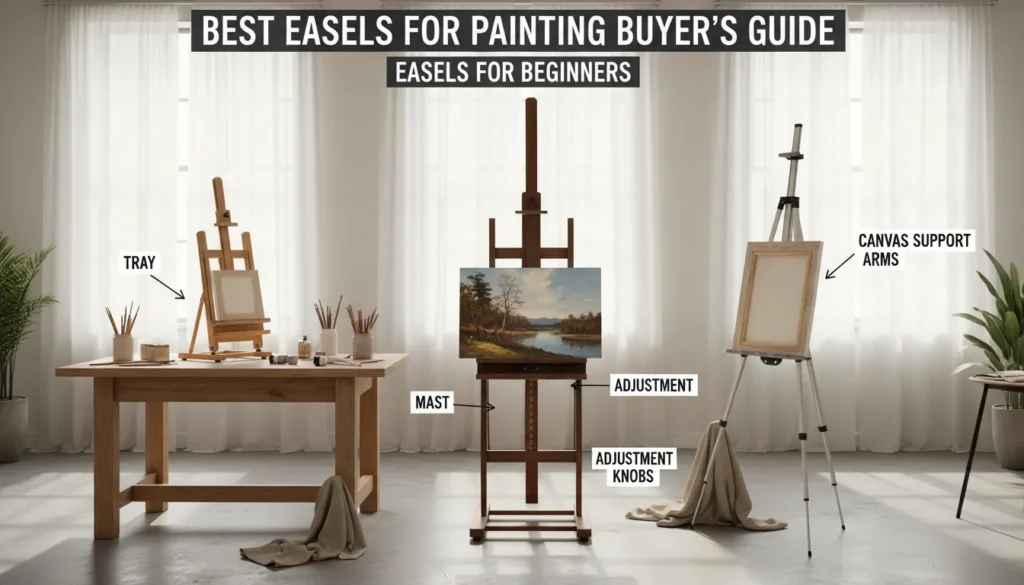
An easel is like a quiet studio assistant: it holds your work steady, sets the angle, and saves your neck and shoulders from hunching. I learned this the hard way after a week of painting flat on a table—my brush control improved overnight the moment I switched to a basic A-frame easel. If you’re choosing easels for the first time (or upgrading), the “best” one is the easel that matches your medium, your space, and your skill level. This guide shows you exactly how to pick, set up, and use easels without wasting money.

How to choose easels by skill level (and why it matters)
Easels aren’t one-size-fits-all because beginners usually need stability and simplicity, while advanced painters often need adjustability and load capacity. Your medium also changes the requirements: watercolor likes a tilt; heavy canvases demand rigid frames; plein air needs portability. In practice, most “easel regret” comes from buying based on looks instead of use-case.
Start with three questions:
- Where will you paint most? (home studio, kitchen table, outdoors)
- What will you paint on? (paper pad, canvas panels, stretched canvas, wood board)
- How big and heavy is it? (height and weight matter more than brand names)
Easel types explained (quick, practical breakdown)
1) A-frame (Lyre) easels: best starter studio choice
A-frame easels are common, affordable, and easy to store. They’re great for small to medium canvases and casual daily practice. The trade-off is less rigidity compared to H-frames, especially with larger work.
Best for:
- Beginners and intermediates
- Acrylic and oil on small/medium canvas
- Small spaces that still want a floor easel
2) H-frame (Studio) easels: best for stability and large canvases
If you paint big or press hard (palette knife, thick impasto), an H-frame easel is the “buy once, cry once” option. It’s heavier, more stable, and often has smoother height/tilt controls. In my experience, it also makes longer sessions easier because it doesn’t wobble when you step back and rework sections.
Best for:
- Intermediate to advanced painters
- Large canvases and heavy boards
- Dedicated studio corners
3) Tripod/field (plein air) easels: best for portability
These prioritize light weight and fast setup. Expect more vibration in wind, but the convenience is unbeatable for outdoor painting. Look for sturdy leg locks, a wide stance, and a carry case.
Best for:
- Travel, classes, outdoor painting
- Small to mid-size supports
- Artists who value compact storage
4) Tabletop easels: best for small work and tight spaces
Tabletop easels are ideal for apartments, kids’ art stations, and small-format work. They’re also a smart second easel for detail painting or varnishing. The limitation is height—your chair and table setup must do the ergonomic heavy lifting.
Best for:
- Beginners, hobbyists, small canvases
- Watercolor pads, sketching, studies
- Shared spaces (kitchen table studios)
Buyer’s checklist: what to look for in easels (the features that actually matter)
You can evaluate most easels in under two minutes if you focus on function. Here’s what I check before buying or recommending an easel:
- Maximum canvas height & weight capacity: Don’t guess—verify. Oversizing slightly prevents upgrades later.
- Tilt range:
- Watercolor: you’ll want adjustable tilt (even near-flat for washes).
- Oil/acrylic: upright is typical, but slight tilt can reduce glare.
- Stability & footprint: Wider base = less wobble. In small rooms, measure the footprint with tape.
- Adjustments (knobs vs. quick-release): Quick-release is faster; knobs can be more secure.
- Material:
- Beechwood is durable and common.
- Aluminum is lighter for travel.
- Cheap softwood can loosen over time.
- Portability: weight, folded length, and whether it fits in a closet or car trunk.

Comparison table: best easels for painting by use case
Use this table to match your real-world needs to the right easel category.
| Skill level / Use case | Best easel type | Why it works | Watch-outs |
|---|---|---|---|
| Beginner (home practice) | A-frame floor easel | Stable enough, affordable, easy to learn | Can wobble with large canvases |
| Beginner (small space) | Tabletop easel | Compact, quick setup, good for studies | Limited height; posture depends on chair/table |
| Intermediate (bigger canvases) | H-frame studio easel | Strong support, smoother controls, less shake | Heavy, takes more space |
| Intermediate (classes/travel) | Tripod/field easel | Packs down, lighter, flexible locations | Wind/vibration; check leg locks |
| Advanced (large/heavy work) | Heavy-duty H-frame | Best stability + capacity + longevity | Higher cost; not portable |
| Watercolor-focused | Tabletop or studio easel with wide tilt | Control wash angles, reduce pooling | Ensure tilt range is truly wide |
How to set up easels correctly (step-by-step)
Step 1: Place the easel for light and comfort
Good lighting prevents bad color decisions. If possible, place the easel so light comes from the side (often the non-dominant side to reduce casting shadows from your hand).
- Keep 2–3 feet behind you for stepping back.
- Avoid placing it where you’ll bump the legs during brush cleaning.
- If glare is an issue, rotate the canvas slightly or change tilt.
Step 2: Adjust height so your shoulder stays relaxed
A reliable rule: set the canvas so the main working area is around chest to eye level. If you feel your shoulder hiking up, lower the canvas. If you keep bending your neck down, raise it.
Quick ergonomic check:
- Elbow near your side
- Forearm moves freely
- No constant shrugging
Step 3: Set the tilt for your medium
Tilt isn’t just preference; it changes how paint behaves.
- Oil/acrylic: mostly upright; slight backward tilt can reduce reflections.
- Watercolor/gouache: start with a modest tilt; increase tilt for controlled washes.
- Ink/markers: moderate tilt can reduce smearing, but test your paper.
Step 4: Secure the support (and stop the “creep”)
Canvas “creep” happens when clamps or trays slowly slip.
- Tighten knobs firmly but don’t over-torque wooden threads.
- Use a non-slip shelf liner on the tray for extra grip.
- For heavy panels, choose an easel with a strong bottom ledge and a reliable top clamp.
Step 5: Stabilize for confident brushwork
If your easel vibrates, your lines will too.
- Widen the stance (tripods: extend legs evenly).
- Add weight low (a sandbag on the base helps for field easels).
- On slick floors, use rubber pads or a rug to prevent sliding.
U.S. Art Supply Medium Wooden H-Frame Studio Easel Review, Super easy to adjust and fits all sizes
Easels for different mediums: quick recommendations
- Acrylic: Choose stability first. Acrylic can involve faster strokes and more pressure, so a sturdier A-frame or H-frame pays off.
- Oil: Consider an H-frame if you paint large or use a palette knife. You’ll appreciate the rigidity when layering thick paint.
- Watercolor: Prioritize a wide tilt range and a surface that won’t wobble when you tape paper down.
- Mixed media: Look for flexible tilt, a strong tray, and easy height changes.
If you’re building a compact art setup, it can help to plan your storage and sourcing ahead of time. For deal-hunting and supplies, see Crafts Stores Near Me: 7 Ways to Find the Best Deals.
Common easel mistakes (and how to avoid them)
Most issues are fixable without replacing the easel.
- Buying too small: If you might paint larger later, buy an easel that can handle at least one size up.
- Ignoring posture: A cheap easel plus good ergonomics beats an expensive easel set too low.
- Over-optimizing for portability: Ultra-light field easels can be frustrating in wind. Balance weight with stability.
- Skipping maintenance: Wooden easels loosen over time; tighten hardware and check joints monthly.
Studio workflow tip: pairing traditional easels with modern making
If you sell art or make painted goods, an easel is often step one—production is step two. In my own workflow, I’ll paint originals on an easel, then digitize designs for making repeatable products (tags, packaging, engraved plaques, stencils). That’s where digital fabrication tools can fit naturally into an artist’s pipeline, especially for small businesses that want consistent results and clean finishing.
If you’re also into craft-based projects and tool setups, you may like Diamond Artz Beginner’s Checklist: Tools, Tips, Setup. And if you’re creating painted gifts, Mother Day Gift Ideas: FAQs for Every Budget can help with packaging and presentation planning.
Trusted references (for deeper reading)
- Encyclopaedia Britannica: Easel
- The Metropolitan Museum of Art — Heilbrunn Timeline of Art History (useful for historical studio practice and painting context)
- Smithsonian American Art Museum (artist methods and collection insights)

Conclusion: picking the best easel is picking your painting habit
An easel isn’t just equipment—it’s the thing that makes painting feel easier to start and easier to finish. When your easel matches your space and medium, you stand better, see better, and paint longer without fatigue. Use the table above to choose your easel type, then follow the setup steps to get the stability and angle right on day one.
FAQ: easels for painting
1) What are the best easels for painting for beginners?
For most beginners, an A-frame floor easel or a sturdy tabletop easel is best. Choose based on space and the canvas sizes you’ll actually use.
2) Do I need an H-frame easel to paint large canvases?
Not always, but it helps. H-frame easels are usually more stable and handle large, heavy canvases better than lightweight A-frames or tripods.
3) What tilt angle should I use on an easel?
Oils and acrylics typically work well close to upright. Watercolor often benefits from a noticeable tilt so washes flow predictably.
4) Are tripod easels good for indoor painting?
They can be, especially for small to medium work. If you notice wobble, widen the stance and add weight to the base.
5) What height should my canvas be on the easel?
Place the main working area around chest to eye level. You should not be shrugging your shoulder up or bending your neck down for long periods.
6) How do I stop my canvas from slipping on an easel?
Tighten clamps, ensure the bottom ledge supports the weight, and add a non-slip shelf liner on the tray for extra grip.
7) Which easel is best for small apartments?
A tabletop easel or a foldable A-frame is usually the most practical. Measure the footprint and consider where it will live when not in use.