
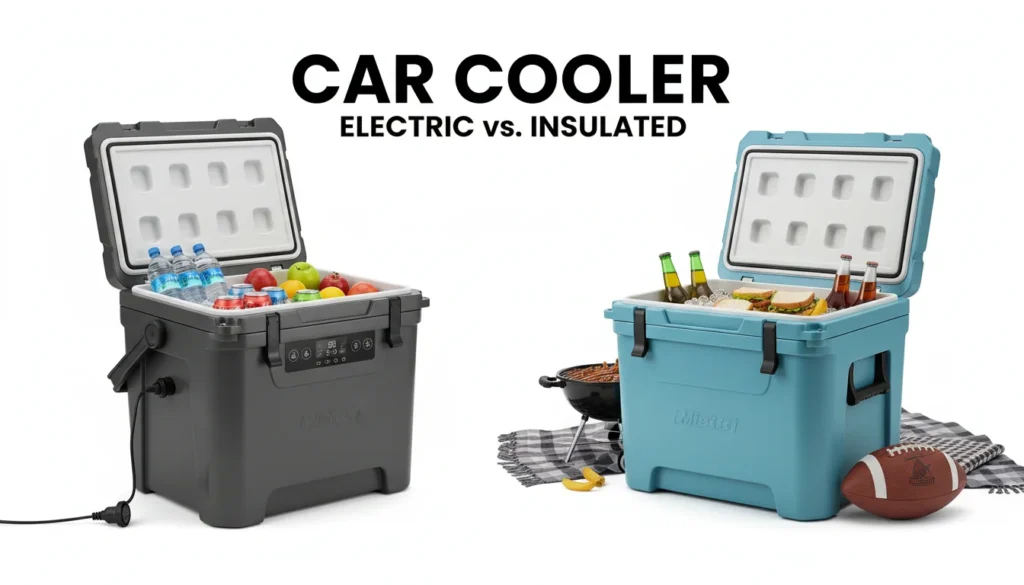
A car cooler is the quiet hero of summer errands, long commutes, and weekend road trips—until it isn’t. I’ve packed “cold” drinks into a trunk at noon and opened them at 4 p.m. to find lukewarm soda and soggy sandwiches. If that’s familiar, the fix usually isn’t “more ice”—it’s choosing the right type of car cooler for your drive, your climate, and how often you stop.
In this guide, you’ll learn how a car cooler actually keeps things cold, when an electric car cooler makes sense, and how to get all-day performance from an insulated option—without overbuying.

What Is a Car Cooler (and Why “Car” Changes Everything)?
A car cooler is any cooler designed to keep food and drinks cold while you’re driving, usually sized to fit in a trunk, back seat, or behind a front seat. The “car” part matters because temperature swings are extreme—parked cars can heat up fast, and each door opening dumps cold air (and your cooling margin).
Most people buy a car cooler for one of three jobs:
- Daily use: commuting, job sites, kids’ sports, grocery runs
- Weekend use: tailgates, beach days, picnics, short camping trips
- Long-haul use: road trips, car camping, overlanding, vanlife
If you’re building a reliable setup, pair a car cooler with insulated drinkware (so your drink stays cold even when you’re outside the vehicle). Corkcicle’s design-first insulation approach—like cold-retention builds and spill-resistant lids—fits naturally into that “layered cooling” strategy.
Types of Car Cooler: Electric vs. Traditional (Insulated)
There are two main categories of car cooler, and they solve different problems.
1) Electric Car Cooler (12V/24V): Fridge/Freezer on the Go
Electric car coolers plug into a vehicle outlet and actively cool. There are two common technologies:
- Compressor electric coolers: Can reach refrigerator temps and often freezer temps; strong performance in hot climates; typically higher cost and weight.
- Thermoelectric coolers: Usually cool to a set amount below ambient temperature (performance drops when the car is very hot); often lighter and more affordable.
Best for: long drives, hot climates, frequent stops, or when you need consistent temps (meds, meal prep, dairy).
2) Insulated Cooler (Hard or Soft): Passive Cooling with Ice
Traditional coolers rely on insulation plus ice/ice packs. They’re simpler, often lighter, and don’t require power—ideal when you’ll carry the cooler away from the car.
Best for: tailgates, beach days, park picnics, short trips, and “grab-and-go” use.
If you want a deeper breakdown of cooler categories, see What Are The Different Types of Coolers?.
| Type | How It Cools | Best For | Pros | Cons | Typical Price Range |
|---|---|---|---|---|---|
| Compressor electric car cooler | Uses a refrigeration compressor (like a mini fridge) to actively chill/freeze | Long trips, camping, keeping food safe, freezing | Can reach freezer temps; works in hot weather; precise temp control | Highest cost; heavier/bulkier; higher power draw; can be noisy | $250–$900 |
| Thermoelectric car cooler | Uses a Peltier module to cool relative to ambient temperature | Short trips, beverages/snacks, mild climates | Lower cost; lightweight; quiet; simple to use | Limited cooling (often ~15–20°C below ambient); struggles in heat; can’t truly freeze | $60–$250 |
| Hard-sided insulated cooler | Passive insulation + ice/ice packs | Tailgating, road trips without power, rough use | Great ice retention; durable; no power needed; high capacity | Needs ice (mess/water); heavier; temp control less precise | $30–$300 |
| Soft-sided insulated cooler | Passive insulation + ice/ice packs | Day trips, tight spaces, portability | Lightweight; easy to carry; flexible storage; often cheaper | Shorter ice retention; less durable; can leak if not sealed | $15–$150 |
How to Choose the Right Car Cooler (A Practical Checklist)
Picking a car cooler is mostly about matching capacity, temperature needs, and your vehicle’s reality (space + power).
Capacity: Don’t Buy “Big”—Buy “Right”
Think in meals and bottles, not quarts.
- 10–20L: lunch + drinks for 1–2 people
- 20–40L: day trips for 2–4 people
- 40L+: family road trips, group tailgates, multi-day travel
Power & Placement (for Electric Car Coolers)
Before you buy, confirm:
- Outlet type (12V socket, USB won’t cut it)
- Where it will sit (trunk airflow, tie-down points, lid clearance)
- Engine off behavior (some vehicles cut power; some don’t—battery risk)
Temperature Goal: “Cold Drinks” vs “Food Safe”
If you’re carrying perishables, aim for fridge-like stability. The USDA emphasizes keeping perishable food out of the “danger zone” and using cold holding practices for safety (see USDA Food Safety and Inspection Service).
Real-World Performance: What Actually Makes a Car Cooler Stay Cold?
Here’s the part most product pages skip: performance is a system. I’ve tested setups where a premium cooler underperformed because it was packed wrong, and a mid-tier cooler did great with smart loading.
For Insulated Car Coolers: Packing Strategy Matters More Than You Think
Use these steps:
- Pre-chill drinks and food overnight (starting cold is huge).
- Use block ice or large ice packs (slower melt than cubes).
- Fill empty space with towels or extra cold items (air is the enemy).
- Keep it shaded in the car (floor behind the passenger seat often beats the trunk in direct sun).
For a step-by-step method, Corkcicle’s guide How to Keep Your Cooler Cold All Day Long is a solid reference.
For Electric Car Coolers: Ambient Heat + Ventilation Decide the Outcome
Electric units need airflow around vents. Avoid stuffing them under blankets or tight against cargo walls. In very hot weather, compressor models typically maintain set temps better than thermoelectric units (which are limited by ambient temperature).

Hard vs. Soft Car Cooler: Which One Fits Your Life?
A car cooler doesn’t just live in your car—it gets carried, cleaned, and stored. Choose based on friction points.
Soft-Sided Car Cooler
- Easier to carry, fits tighter spaces, often lighter
- Great for day trips and quick errands
- Typically less ice retention than hard coolers (varies by build)
Hard-Sided Car Cooler
- Better structure, often stronger insulation
- Great for longer days, rougher handling, and stacking
- Bulkier to move and store
If you’re deciding between these two specifically, Hard vs Soft Cooler: Which One’s For You? lays out the tradeoffs clearly.
Car Cooler “Loadouts”: 3 Setups That Work
1) The Commuter Setup (Simple + Clean)
- Small soft car cooler for lunch
- 1–2 slim ice packs
- Insulated bottle for water + insulated cup for coffee
This reduces the number of times you open the cooler (each open is a temp hit).
2) The Road Trip Setup (High Reliability)
- Electric car cooler for food safety and consistency
- Separate insulated bag for “grab drinks”
- Keep frequently accessed items outside the main cooler zone
3) The Tailgate Setup (Fast Access)
- Hard or large soft cooler with block ice
- Drinks on top, food in a separate sealed container
- A dedicated insulated cup per person (less cooler opening)
12v coolboxes: thermoelectric vs compressor. A nerdy showdown (with teardowns and testing)
Common Car Cooler Problems (and Fixes)
-
“My car cooler isn’t cold enough.”
- Electric: check ventilation, set temp, and whether the car outlet supplies enough power.
- Insulated: pre-chill contents and switch to larger ice packs or block ice.
-
“Everything is wet.”
- Use sealed ice packs, or separate items in waterproof bins/bags.
-
“It takes up too much space.”
- Downsize capacity and optimize packing; a half-empty cooler performs worse anyway.
For broader best practices on keeping drinks cold when you’re hosting or traveling, CDC food safety guidance is also worth bookmarking.
Conclusion: The Best Car Cooler Is the One You’ll Actually Use
A car cooler should make your day easier—not add another gadget to manage. If you need consistent, food-safe temps in heat, an electric car cooler is often worth it. If your use is more beach-day and tailgate than cross-country, a well-packed insulated car cooler can deliver excellent results with less cost and complexity.
If you’re building your own car-cooler routine, tell me what you’re packing (drinks only, lunches, or full meals) and what you drive—those two details usually determine the best setup fast.
FAQ: Car Cooler Questions People Also Ask
1) What size car cooler do I need for a road trip?
Most couples do well with 20–40L; families often prefer 40L+ depending on meals and days between stops.
2) Are electric car coolers worth it?
Yes if you need stable temperatures in hot conditions, carry perishables, or travel for long hours with frequent stops.
3) Do thermoelectric car coolers work in very hot weather?
They can struggle because cooling performance depends on ambient temperature; compressor models usually handle heat better.
4) Where should I put a car cooler for best performance?
Out of direct sun, with airflow around it (especially electric units). Behind a seat can outperform a sun-baked trunk in some vehicles.
5) How do I keep my cooler cold all day in the car?
Pre-chill contents, use large ice packs/block ice, minimize opening, and reduce empty air space. See How to Keep Your Cooler Cold All Day Long.
6) Can I run a car cooler overnight?
Some electric coolers can, but it depends on your vehicle’s power behavior and battery capacity. Consider battery protection features and ventilation.
7) What’s better for a car: hard or soft cooler?
Soft coolers win on portability and fit; hard coolers usually win on structure and longer ice retention.