
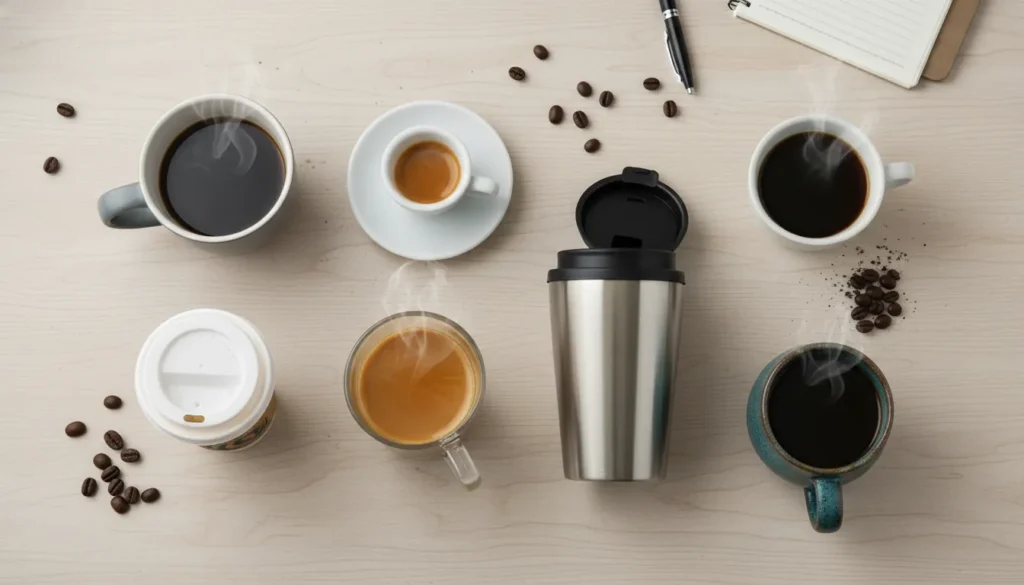
The coffee cup you reach for says a lot about your morning: rushed commute, slow kitchen ritual, or “I need this to last through back-to-back calls.” I’ve tested everything from paper to ceramic to insulated stainless in real life (including the inevitable “tossed in a bag” moment), and the right shape and lid matter more than most people think. Are you chasing hotter coffee for longer, better aroma, fewer spills, or just a cup that looks as good as it performs? Let’s break down the most common coffee cup styles—what they’re best at, where they fail, and how to choose fast.

How to Choose a Coffee Cup (Quick Checklist)
Before the list, here’s the decision filter I use when advising friends and coworkers on a coffee cup:
- Where will you drink it? Desk, car, outdoors, café, or home.
- How long do you sip? 10 minutes (open cup is fine) vs. 2 hours (insulation wins).
- Spill risk: One-handed commute calls for a secure lid (ideally 360° sip).
- Taste priority: Ceramic and glass are “pure” tasting; some metals can add notes if unlined.
- Cleaning tolerance: Narrow lids and straws demand more maintenance than open mugs.
If your main goal is heat retention, you’ll also like How to Keep Coffee Hot All Day.
21 Coffee Cup Styles (Pros, Cons, and Best Use)
1) Classic Ceramic Mug
A classic coffee cup for home and office: thick walls, comfortable handle, easy to clean. It’s great for drip coffee and lattes, and it feels “cozy” in your hands. The downside is heat loss—your coffee cools quickly unless you’re sipping fast.
- Best for: Home ritual, desk sipping
- Watch for: Chipped rims and stained glaze over time
2) Porcelain Mug
Porcelain is lighter and often more refined than stoneware ceramic. It holds heat reasonably well and looks sharp on a shelf or meeting table. It can be more fragile, so it’s not my first choice for busy kitchens.
- Best for: Aesthetic kitchens, guest-ready drinkware
- Watch for: Breakage and hairline cracks
3) Stoneware Mug
Stoneware tends to be heavier with a satisfying heft and excellent durability. I’ve found it retains warmth better than thin ceramic mugs, especially in larger sizes. It’s a dependable everyday coffee cup when you want comfort plus sturdiness.
- Best for: Daily use, bigger pours
- Watch for: Some reactive glazes can stain if not rinsed promptly
4) Diner Mug (Thick-Walled)
That iconic, chunky diner mug is built for constant refills and heavy use. Thick walls keep coffee warmer than you’d expect, and the wide top cools it just enough to drink sooner. It’s not compact, but it’s a workhorse.
- Best for: All-day refills at home
- Watch for: Bulky storage
5) Camp Mug (Enamel or Steel)
Camp mugs are rugged, lightweight, and built to survive outdoors. Enamel versions can chip; steel versions can run “metallic” with some coffees. For trail mornings, they’re a classic coffee cup choice.
- Best for: Camping, patios, fire pits
- Watch for: Heat transfer—handles can get hot depending on build
6) Travel Mug (Insulated Stainless)
If you commute, this is the MVP coffee cup style. Double-wall vacuum insulation can keep drinks hot for hours, and a good lid prevents spills. I’ve learned the hard way to prioritize a lid that’s easy to disassemble—gunk hides in crevices.
- Best for: Commutes, errands, long meetings
- Watch for: Lid parts that are hard to clean
For commute-specific heat strategies, see How to Keep Hot Drinks Warm on Your Commute.
7) Commuter Cup (360° Sip Lid Style)
A commuter-focused coffee cup usually means one-handed drinking and fast access—often via a 360° sip lid. This style is ideal when you’re juggling a phone, keys, and a bag. It’s less “café romantic,” more “real life efficient.”
- Best for: One-handed drinking, walking to work
- Watch for: Toss-proof claims—test it before trusting a new lid in a backpack
8) Ceramic-Lined Stainless Mug
This hybrid coffee cup style is popular for a reason: stainless insulation + ceramic interior for cleaner taste. In side-by-side tests at my desk, ceramic-lined interiors reduce that lingering “metal” note in delicate coffees. It’s a premium upgrade if flavor is your main priority.
- Best for: Specialty coffee drinkers on the go
- Watch for: Drops—ceramic lining can crack if abused
9) Glass Coffee Cup (Single Wall)
Glass looks beautiful and keeps the experience visual—great for layered drinks. It’s neutral for taste and easy to rinse. The downside is heat transfer: it gets hot to hold and cools fast.
- Best for: Iced-to-hot versatility, aesthetics
- Watch for: Fragility and hand comfort
10) Double-Wall Glass Cup
Double-wall glass adds insulation and makes the cup more comfortable to hold. It’s excellent for cappuccinos, cortados, and smaller lattes where you want heat without a handle. It’s still breakable, but it’s a more functional glass coffee cup.
- Best for: Espresso drinks, modern kitchens
- Watch for: Not all are dishwasher-friendly—check manufacturer guidance
11) Espresso Demitasse Cup
Small, thick, and designed to hold crema warmth and aroma. Demitasse cups are the traditional coffee cup for straight espresso. If you pull shots at home, this is a worthwhile “tiny upgrade” that feels big.
- Best for: Espresso shots
- Watch for: Too small for lungo drinkers
12) Cappuccino Cup (Rounded, Heat-Friendly)
A cappuccino cup is usually 150–180 ml with a rounded interior that supports microfoam. The shape helps keep foam integrated, which improves texture and aroma. It’s the right coffee cup if you make cappuccinos frequently.
- Best for: Cappuccinos, smaller milk drinks
- Watch for: Needs saucer storage space if you buy sets
13) Latte Cup (Wider, Larger Volume)
Latte cups run larger with a wide mouth for foam and latte art. They’re comfortable, café-like, and great for 10–12 oz pours. Because of the wide opening, they can cool faster than narrower shapes.
- Best for: Lattes, café-style serving
- Watch for: Faster cooling; consider preheating the cup
14) Cortado / Gibraltar Glass
Often served in a small glass with straight sides, the cortado glass is sturdy and looks sharp. It highlights coffee-to-milk balance and keeps portions consistent. It’s a specific coffee cup style, but it’s a favorite for people dialing in espresso recipes.
- Best for: Cortados, macchiatos
- Watch for: Hot-to-hold without a sleeve or double wall
15) Turkish Coffee Cup (Fincan)
Small and decorative, a fincan is designed for unfiltered Turkish coffee. The size supports slow sipping and lets grounds settle. If you drink Turkish coffee regularly, this cup shape improves the whole ritual.
- Best for: Turkish coffee
- Watch for: Not multipurpose—too small for most other drinks
16) Paper To-Go Cup (Disposable)
It’s the “grab-and-go” coffee cup you see everywhere, and it’s built for convenience. Heat retention varies, and lids can be hit-or-miss for leaks. It’s common in cities (think the iconic New York style), but it’s not the best for taste or sustainability.
- Best for: Quick café pickups, events
- Watch for: Soggy sleeves, flimsy lids, waste
17) Reusable To-Go Cup (Barista-Friendly)
Reusable to-go cups are designed to match café sizes and fit under espresso machines. Many are splash-resistant rather than fully leakproof, which is realistic and helpful to understand. If you buy coffee out often, this coffee cup style pays off fast.
- Best for: Café regulars
- Watch for: Don’t assume “leakproof” unless explicitly tested
18) Collapsible Coffee Cup
Collapsible cups pack down small for travel or minimalist bags. They’re convenient, but they can retain odors if not cleaned and dried promptly. I only recommend this coffee cup style if portability is a top priority.
- Best for: Travel, backup cup in a bag
- Watch for: Silicone smell and cleaning diligence
19) Handleless Tumbler (Open Top)
This is a sleek, modern coffee cup option for desks and homes—easy to hold, easy to wash. It’s not for walking around unless you like living dangerously. For many people, it’s the simplest “daily driver” when you drink at a table.
- Best for: Desks, kitchen counters
- Watch for: Spills and faster heat loss without a lid
20) Insulated Cup with Straw Lid (Iced Coffee Crossover)
While straws are more associated with cold drinks, plenty of people use these cups for iced lattes and cold brew. They’re comfortable for long sipping sessions and can be very leak-resistant with the right design. It’s not a hot-coffee-first coffee cup, but it belongs in a modern lineup.
- Best for: Iced coffee, all-day hydration + caffeine
- Watch for: Straw and gasket cleaning
21) Oversized “Soup Mug” / Extra-Large Mug
Sometimes you want a huge cup—think long mornings or slow weekends. Oversized mugs can be cozy, but the bigger the volume, the more likely your drink cools before you finish unless you use insulation. If you love big pours, consider pairing the size with better heat control.
- Best for: Big-batch mornings, tea + coffee drinkers
- Watch for: Weight, cabinet space, cooling
| Coffee cup style | Typical size (oz) | Best for | Heat retention (Low/Med/High) | Spill resistance (Low/Med/High) | Taste neutrality (Low/Med/High) |
|---|---|---|---|---|---|
| Classic ceramic mug | 10–14 | Drip coffee, tea at home/office | Med | Low | High |
| Diner mug | 8–12 | Refills, diner-style drip coffee | High | Low | High |
| Double-wall glass | 8–12 | Lattes, cappuccinos, presentation | High | Low | High |
| Espresso demitasse | 2–3 | Espresso shots | Med | Low | High |
| Travel mug (vacuum insulated) | 12–20 | Commuting, long sips over hours | High | High | Med |
| Ceramic-lined stainless travel mug | 12–16 | Commuting with better flavor preservation | High | High | High |
| Paper to-go cup | 8–16 | Takeaway coffee, short trips | Med | Med | Med |
| Reusable barista cup | 8–16 | Cafe takeout, reducing waste | Med | Med | High |
| Collapsible cup | 8–12 | Backpacking, emergency carry | Low | Low | Low |
| Handleless tumbler | 8–16 | Iced coffee, quick at-desk sipping | Low | Low | Med |
What Most People Actually Buy (and Why)
In retail patterns I’ve seen across drinkware, most shoppers cluster into a few “jobs to be done”: commute, desk, and weekend lounging. If you’re deciding between categories, it helps to compare adoption by use case rather than by looks.

Common Coffee Cup Problems (and Simple Fixes)
A coffee cup isn’t just a container—it’s a system (rim + wall thickness + lid + base). Here are the issues I see most often, plus fixes that don’t require buying a whole new collection.
- Coffee cools too fast: Preheat the cup, use a lid, choose vacuum insulation, or size down.
- Metallic aftertaste: Try ceramic-lined or glass interiors, and avoid leaving coffee sitting for hours.
- Spills in the car/bag: Prioritize leak-resistant lids and test with water first.
- Hard-to-clean lids: Pick designs that come apart fully; rinse immediately after use.
For maintenance, bookmark How to Clean Stainless Steel Coffee Mugs.

My “Perfect Coffee Cup” Rule of Thumb (From Testing)
After carrying a coffee cup through commutes, flights, and long desk days, my rule is simple: match the cup to the moment. Open mugs win on comfort and aroma; insulated cups win on temperature control and chaos-proofing. When someone wants one option that covers the most situations, I steer them toward an insulated commuter cup with an easy-clean lid and a taste-neutral interior.
If you’re also comparing broader categories, Corkcicle’s breakdown is useful: Tumbler vs Travel Mug: What’s the Difference?.
Ceramic Coffee Mug vs Stainless Steel Coffee Mug: Which is Better for Your Morning Brew?
Expert Notes: Materials and Heat Retention (What to Trust)
Materials influence taste and temperature more than branding. Vacuum insulation (double-wall stainless with a sealed air gap) is the most effective mainstream method for keeping coffee hot, while ceramic and glass tend to be best for neutral flavor. For deeper science on heat transfer and insulation principles, see U.S. Department of Energy guidance on insulation and thermal performance, and for food-contact material considerations, reference U.S. FDA food contact substances overview. For a broader sustainability perspective around disposable cups and waste, the U.S. EPA overview on sustainable materials management is a helpful starting point.
Conclusion: The Coffee Cup That Fits Your Life
A coffee cup should feel like it’s on your side—keeping your drink the right temperature, tasting the way it should, and moving with you without drama. If you’re mostly at home, a great ceramic or stoneware mug is hard to beat; if you’re mobile, insulated and spill-resistant designs change the day. Pick one style that matches your most common moment, then add a second that covers your “edge case” (commute, travel, or guests).
FAQ: Coffee Cup Styles and Buying Questions
1) What is the best coffee cup for keeping coffee hot?
A vacuum-insulated stainless travel mug or commuter cup typically performs best, especially with a well-sealed lid.
2) Does a ceramic-lined coffee cup really improve taste?
In my experience, yes—ceramic-lined interiors often reduce metallic notes and preserve delicate aromas better than bare stainless.
3) What coffee cup size should I buy for daily use?
Most people do well with 10–14 oz for drip coffee or lattes; espresso drinks need 2–6 oz depending on the recipe.
4) Are reusable coffee cups actually barista-friendly?
Many are designed to fit under espresso group heads and match common café sizes, but not all are fully leakproof—check the lid type.
5) What’s the difference between a mug and a cup?
“Mug” usually implies a handle and larger size; “cup” can include handleless or smaller formats like espresso cups and glass cups.
6) What coffee cup is best for commuting without spills?
Look for a commuter cup with a secure, tested lid (ideally one-handed operation) and a non-slip base.
7) How do I stop my coffee cup lid from smelling like old coffee?
Disassemble the lid, wash all parts, and let everything dry completely; lingering odors often come from trapped moisture in gaskets.