
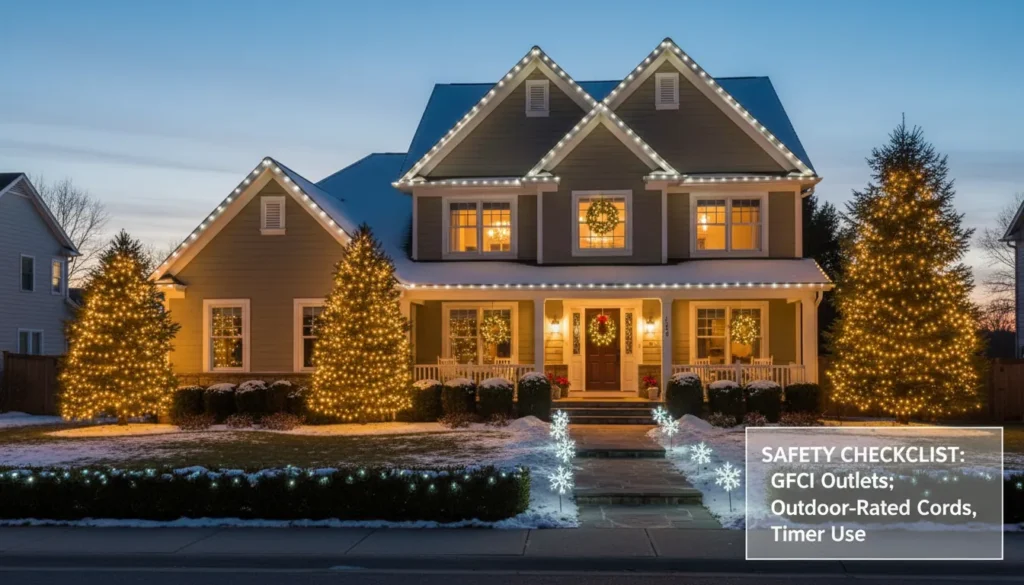
You know that feeling when the first string of lights goes up and the house suddenly looks “holiday-ready”? Lighting Xmas is more than decoration—it’s a mix of design choices, electrical safety, weatherproofing, and energy planning. If you’ve ever wondered why some lights last for years while others fail mid-season, or how to make your display brighter without spiking your bill, this guide breaks it down. I’ve tested enough strands (and replaced enough fuses) to learn that a little planning upfront saves hours of troubleshooting later.

What “Lighting Xmas” Usually Includes (and Why It Matters)
Most Lighting Xmas setups blend three layers: outline lighting (roofline, windows), focal lighting (tree, wreath, yard figure), and functional lighting (pathways, steps). Thinking in layers helps you avoid the common “bright roof, dark yard” imbalance. It also helps you pick the right product type—because the best roofline lights aren’t always the best for wrapping a tree.
A practical approach is to decide your goal first:
- Classic glow: warm white, steady-on, minimal flash
- High-impact: color-changing, synchronized effects, strong focal points
- Low-effort: pre-lit items, net lights, timers, fewer extension runs
Types of Xmas Lights: Pros, Cons, and Best Uses
1) LED vs Incandescent
LED dominates modern Lighting Xmas for good reasons: it uses less power, runs cooler, and typically lasts longer. Incandescent lights can still look “nostalgic,” but they consume more energy and generate more heat—important when you’re wrapping dry greenery or using dense clusters.
Key differences you’ll notice in real use:
- LED: crisp colors, low energy, safer temperatures, often dimmable via controllers
- Incandescent: softer warmth, higher power draw, more frequent bulb failures
2) String, Net, Icicle, and Rope Lights
Each format solves a different problem:
- String lights: flexible, best for trees, railings, rooflines with clips
- Net lights: fastest for shrubs; coverage looks uniform with minimal effort
- Icicle lights: classic eaves look; choose consistent drop lengths for cleaner lines
- Rope/neon flex: great for outlines/sign shapes; check bend radius and outdoor rating
3) Smart Lights vs Plug-and-Play
Smart systems can schedule, dim, and animate patterns, but they add complexity (apps, Wi‑Fi range, controller weatherproofing). Plug-and-play is simpler and often more reliable in harsh weather.
If you’re deciding:
- Choose smart if you want scenes, music sync, or remote control.
- Choose plug-and-play if you want “set it once” reliability.
Safety First: The Non-Negotiables for Lighting Xmas
Electrical safety is where most holiday lighting problems start. I’ve seen the same issues repeat: indoor cords outdoors, overloaded power strips, and “temporary” connections left in puddles. A safe Lighting Xmas setup isn’t hard—it’s just systematic.
Outdoor Electrical Checklist
- Use outdoor-rated light strings and extension cords (look for weather/UV rating on packaging).
- Plug outdoor displays into GFCI-protected outlets (many outdoor receptacles have built-in GFCI).
- Keep all connections off the ground using stakes, hooks, or weatherproof covers.
- Avoid daisy-chaining beyond the manufacturer’s limit (especially for older or non-LED strands).
- Use timers or smart plugs to reduce runtime and prevent overheating.
Ladder and Roofline Safety
- Use plastic light clips instead of staples/nails (prevents wire damage).
- Place the ladder on stable ground; maintain three points of contact.
- Don’t work in wind, rain, or icy conditions—even “quick fixes” go wrong fast.
For general electrical guidance, refer to resources like the U.S. Consumer Product Safety Commission (CPSC), and for cord/outdoor use standards, consult NFPA electrical safety guidance.
Energy Use: How Much Power Does Lighting Xmas Really Take?
The fastest way to control cost is to understand watts, hours, and how many strings you run. LEDs typically use a fraction of the power of incandescent mini lights, so you can expand your display without multiplying your bill.
Here’s a practical rule:
Cost ≈ (Watts ÷ 1000) × Hours × Electric rate

Quick Comparison Table (Typical Values)
| Light type (per ~100-count string) | Typical watts | Heat output | Best for | Energy impact |
|---|---|---|---|---|
| LED mini lights | 4–8W | Low | Rooflines, trees, shrubs | Lowest |
| Incandescent mini lights | 35–45W | Higher | Warm nostalgic look | Highest |
| LED C7/C9 (retro style) | 1–7W (varies) | Low | Big visual bulbs outdoors | Low |
| Rope / neon flex LED | 3–10W per meter (varies) | Low | Outlines, signage | Low–medium |
Note: Always check your product label; wattage varies by brand, length, and effects.
Weatherproofing: What “Outdoor-Rated” Really Means
Outdoor-rated doesn’t mean “waterproof in any situation.” It usually means the materials and sealing are designed to handle moisture, temperature swings, and UV exposure when installed properly.
For better winter reliability:
- Route cords so water drips away from connections (a “drip loop”).
- Use weatherproof connection covers for plugs exposed to snow/rain.
- Avoid crushing cords in windows/doors; it can damage insulation over time.
Design Tips: Make Lighting Xmas Look Intentional (Not Random)
A clean display is rarely about “more lights.” It’s about consistency and focal points.
Try this layout approach:
- Pick one color temperature for whites (warm or cool). Mixing often looks patchy.
- Outline first: roofline and windows create structure.
- Add one hero feature: a tree wrap, wreath, or yard element.
- Balance brightness: if the roof is bright, add pathway or shrub lighting to match.

Making and Customizing Holiday Decor with xTool (Practical Ideas)
A standout Lighting Xmas setup often includes custom signs, ornaments, and light-up props—especially if you’re aiming for a cohesive theme (family name, address numbers, or a “North Pole” sign). In my experience, pairing lighting with laser-cut decor makes the whole display look more “designed” and less like a collection of store-bought pieces.
With xTool machines, common projects that pair well with holiday lighting include:
- Laser-cut window silhouettes (wood or acrylic) that backlight nicely
- Engraved ornaments that reflect mini lights on the tree
- Custom address plaques for better visibility in winter evenings
- Layered shadow-box signs with internal LED strips
If you’re exploring design-to-finished workflows, the xTool Studio software helps streamline settings and layout, and the xTool M1 Ultra is a versatile option when you want to combine cutting, plotting, and creative detailing in one platform. For higher-throughput holiday production (selling signage or ornaments), the xTool P2 CO2 laser is commonly chosen for speed and clean cuts on thicker materials.
For broader efficiency guidance and energy comparisons, the U.S. Department of Energy is a solid reference for understanding lighting efficiency basics.
Common Problems (and Fast Fixes)
- Half a string is out
- Likely a failed bulb/section (or a loose connection). Check for damaged sockets and reseat connectors.
- Lights flicker randomly
- Controller issue, moisture in connection, or overloaded run. Dry connections and reduce daisy-chain length.
- Breaker trips
- Too much load or moisture fault. Move to GFCI circuit, reduce wattage, and inspect cords for damage.
- Outdoor timer fails
- Not outdoor-rated or not sealed. Upgrade to an outdoor timer with a cover and proper amperage rating.
FAQ: Lighting Xmas
1) How many hours should I run Lighting Xmas each night?
Most people run 4–7 hours. A timer (or smart plug) keeps it consistent and reduces energy use.
2) Are LED Xmas lights safe to leave on overnight?
They’re safer than incandescent due to lower heat, but “safe” still depends on outdoor-rated gear, dry connections, and not overloading circuits. Use a timer instead of overnight runs.
3) What’s the best way to attach lights to gutters and shingles?
Use purpose-made plastic clips designed for your roofline type. Avoid staples or nails that can damage insulation.
4) How do I calculate Lighting Xmas electricity cost?
Add up total watts, convert to kW (÷1000), multiply by hours used and your $/kWh rate.
5) What IP rating should outdoor holiday lights have?
Many holiday products don’t list IP ratings clearly; focus on “outdoor-rated” labeling and proper installation. For exposed areas, look for stronger weather sealing and covered connectors.
6) Why do my outdoor connections keep failing in snow/rain?
Usually water pooling at plugs. Use drip loops, raise connections off the ground, and use weatherproof covers.
7) Can I mix different brands or types of Xmas lights on one run?
Yes, but keep voltage/type compatible, respect the lowest-rated limit, and don’t exceed amperage. LEDs and incandescent mixed together can complicate dimming and controllers.
Conclusion: A Brighter, Safer Lighting Xmas (Without Wasting Power)
Lighting Xmas works best when it’s planned like a simple system: choose the right light types, install with weatherproof safety habits, and control runtime with timers. The payoff is a display that looks intentional, survives bad weather, and costs less to run. If you want to go beyond “lights only,” adding custom laser-cut decor can make your theme feel uniquely yours—and that’s often what people remember.