
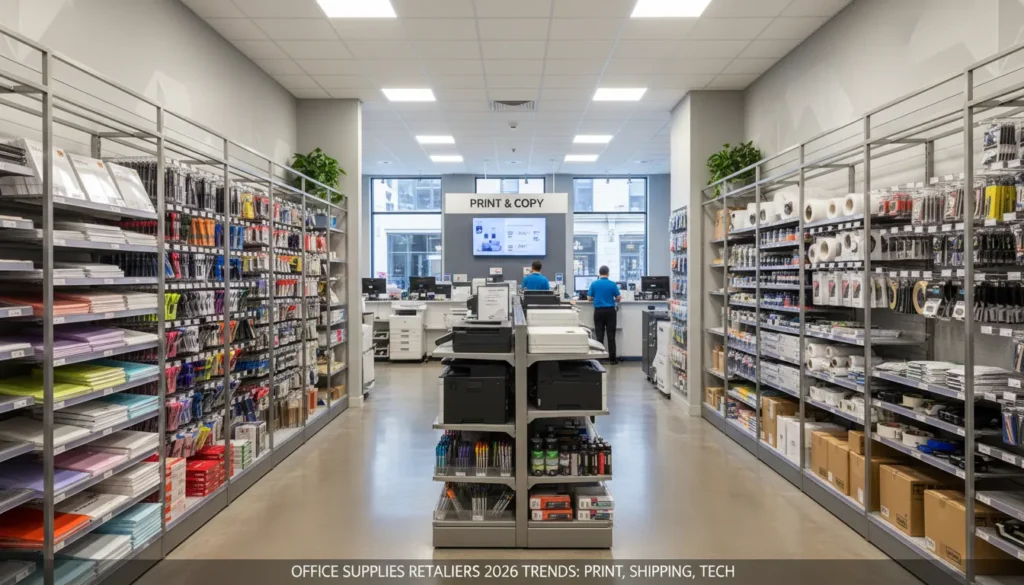
The office-supplies aisle is having an identity crisis—in a good way. One minute you’re buying printer paper, the next you’re sourcing shipping labels, acrylic signage, custom stamps, and branded swag for a side hustle. I’ve watched this shift firsthand: the retailers winning now aren’t just “stores,” they’re fulfillment hubs for small businesses, hybrid workers, schools, and creators. So which office supplies retailers will matter most in 2026, and how do you choose the right one for your needs?

What counts as an “office supplies retailer” in 2026?
In 2026, office supplies retailers span three main models, and the best ones blend all three. The classic big-box store still matters, but it’s now competing with online-first sellers and niche specialists. The category also widened into printing, shipping, tech services, and small-business support.
Here’s what shoppers increasingly expect:
- Reliable basics: paper, ink/toner, writing tools, folders, labels, cleaning supplies
- Services: print/copy, business cards, signage, device setup, recycling, shipping drop-off
- Business enablement: subscription pricing, delivery, bulk ordering, tax-exempt accounts
For a quick landscape view, see how large retailers are positioned in National Retail Federation coverage and broader retail trend reporting via McKinsey retail insights.
2026 trend forecast: what will reshape office supplies retailers?
1) Hybrid work becomes “distributed purchasing”
Companies are buying less from one corporate buyer and more from many individual employees. That pushes office supplies retailers to improve:
- easy reordering and saved carts
- predictable delivery windows
- transparent substitutions (especially for ink, paper, and planners)
Practical takeaway: choose retailers with strong order history, account controls, and consistent inventory—not just low prices.
2) Print isn’t dead—it’s moving to “on-demand”
Print/copy counters are becoming mini production studios: posters, menus, labels, stickers, and short-run marketing. If you print even twice a month, retailer print quality and turnaround time matter more than aisle selection.
If you’re comparing printing workflows and deal-hunting across categories, this guide can help: Crafts Stores Near Me: 7 Ways to Find the Best Deals.
3) “Office supplies” now includes maker-friendly and micro-manufacturing needs
Small businesses are increasingly producing packaging inserts, engraved nameplates, QR-code placards, custom stamps, and branded goods in-house. I tried this route for a small project run (labels + engraved tags) and found the real savings came from speed and control, not just unit cost.
That’s where a digital fabrication ecosystem can complement traditional office supplies retailers. If your business is scaling beyond basic printing, tools like laser engraving/cutting and apparel printing can convert office spend into sellable products—especially when you need fast iteration.
For consumer and small-business trend context, Deloitte consumer signals is a helpful reference.
Who will be the “winners” among office supplies retailers in 2026?
The winners won’t be defined by store count alone. They’ll win by being the easiest place to keep a business running.
Winner profile A: The “service-led” retailer
These office supplies retailers win when they:
- deliver consistent print quality (color accuracy, paper options, finishing)
- offer same-day pickup and clear proofs
- provide shipping integration (labels, packaging, drop-off)
Best for: small offices, schools, events, real estate teams, and local businesses.
Winner profile B: The “inventory + speed” retailer (omnichannel)
They win by preventing downtime:
- strong local inventory visibility
- accurate pickup readiness times
- reliable substitutes and easy returns
Best for: IT admins, office managers, and anyone who can’t wait 3–5 days for toner.
Winner profile C: The “business account” retailer
They win through:
- contract pricing or tiered discounts
- invoicing, approvals, and tax-exempt handling
- bulk + recurring purchase workflows
Best for: multi-location teams, nonprofits, and growing SMBs.
Quick comparison: choosing the best store for office supplies (by need)
Use this table to match your situation to the right type of office supplies retailers. The “best store” depends on what you’re optimizing: price, speed, services, or business controls.
| Your primary need | Best retailer type | What to look for | Common pitfalls |
|---|---|---|---|
| Lowest cost on basics | Online marketplace / club pricing | bulk packs, reorder discounts, clear unit pricing | inconsistent brands, variable quality |
| Same-day essentials | Omnichannel big-box | real-time inventory, curbside pickup, easy returns | pickup delays, substitutions |
| Print/copy & marketing | Service-led retailer | proofing, finishing (lamination, binding), turnaround | hidden fees, color mismatch |
| Shipping + packing supplies | Retailer with shipping counter | label printing, drop-off, packaging variety | limited sizes, high per-unit cost |
| Managed business purchasing | Business account-focused | approvals, invoicing, contract SKUs | complex setup, limited consumer promos |
| Maker-style customization | Retail + in-house production | tools/material settings, safety gear, repeatability | learning curve, upfront equipment cost |
Chain questions people ask (and what to know)
What retail chain is famous for office supplies?
Historically, the most famous office supplies retailers were the dedicated big-box chains (the names most people recall first). In 2026, “famous” still matters for convenience, but service quality and omnichannel execution matter more than brand recognition.
What is the best store for office supplies?
“The best” depends on your buying pattern:
- If you buy weekly basics: prioritize inventory accuracy + easy reorders.
- If you print frequently: prioritize print consistency and finishing options.
- If you run a small business: prioritize business accounts, shipping supplies, and tax handling.
What’s another store like Office Depot?
Comparable alternatives usually fall into:
- other big-box office retailers (similar footprint and services)
- mass retailers with strong office aisles
- online retailers with fast delivery
- local print shops for high-quality production work
Your best substitute is the one that matches your most frequent job-to-be-done (pickup speed vs. print vs. bulk).
What is OfficeMax called now?
Office retail branding has consolidated over time, and some names now operate under shared corporate ownership or unified store/online experiences. If you’re unsure, check the current store locator and branding on the retailer’s official site before setting up accounts or subscriptions.
How to evaluate office supplies retailers (a practical checklist)
When I audit a retailer for a team, I score it like a workflow, not a storefront. This reduces “surprise costs” like downtime, rush shipping, and reprints.
- Availability reliability: are top 20 items consistently in stock?
- Total cost: include delivery fees, minimums, returns, and reprint risk.
- Speed options: pickup, same-day, next-day—what’s real in your ZIP code?
- Print accuracy: can they match colors and paper reliably?
- Business features: invoicing, approvals, tax exemption, multi-user accounts.
- Support: how fast can you resolve a wrong toner, torn paper case, or print issue?

Where xTool fits: beyond office supplies into “office production”
If your “office supplies” spend is increasingly about making things (signage, packaging, labels, personalized gifts, branded products), a digital fabrication setup can outperform repeated outsourcing. xTool’s lineup—laser cutters/engravers (CO2, diode, fiber, and UV options), MetalFab welding/metalworking, and an apparel printer—targets exactly that bridge between office operations and product output.
Common office-adjacent use cases I see work well:
- engraved desk plates, QR signs, and compliance labels
- custom packaging inserts and product tags
- branded acrylic/wood signage for events and storefronts
- short-run personalization that would be slow or expensive through print queues
The real advantage is repeatability: with software-driven settings and material libraries, you can standardize outcomes the same way you standardize paper and toner purchases.
Etsy Showdown: Digital Products vs Print-on-Demand (What I’d Choose in 2026)

Conclusion: the 2026 playbook for office supplies retailers (and buyers)
By 2026, office supplies retailers that win will feel less like aisles and more like operating systems: fast replenishment, dependable print, business controls, and smooth omnichannel pickup. If you’re buying for a team, optimize for reliability and workflow—not just promo pricing. And if your needs are drifting toward customization and short-run production, consider pairing a strong retailer with in-house making tools to cut delays and unlock new revenue.
📌 xTool Apparel Printer: One Click DTF Printer, Effortless Customization for Business
FAQ: office supplies retailers (2026)
1) Are office supplies retailers still relevant in 2026?
Yes—especially for same-day essentials, print services, returns, and business purchasing workflows.
2) What should I buy in-store vs online?
Buy in-store when you need it today (ink, folders, last-minute print jobs). Buy online for bulk basics and recurring orders.
3) How do I lower office supply costs without sacrificing quality?
Standardize a small list of approved SKUs, track unit prices, and reduce “emergency buys” by setting reorder thresholds.
4) Which office supplies retailers have the best print services?
The best option is the one with consistent proofs, finishing options, and reliable turnaround in your local area—test with one small job first.
5) What’s a good alternative to big-box office supply chains?
Try mass retailers for basics, online-first sellers for bulk, and local print shops for premium print quality and specialty finishing.
6) How do small businesses choose office supplies retailers?
Prioritize delivery reliability, business accounts/invoicing, shipping supplies, and print quality—then optimize pricing second.
7) When does it make sense to bring customization in-house?
When you repeat the same personalized items (labels, tags, signage, branded goods) often enough that outsourcing causes delays or costs more than the time + equipment investment.