
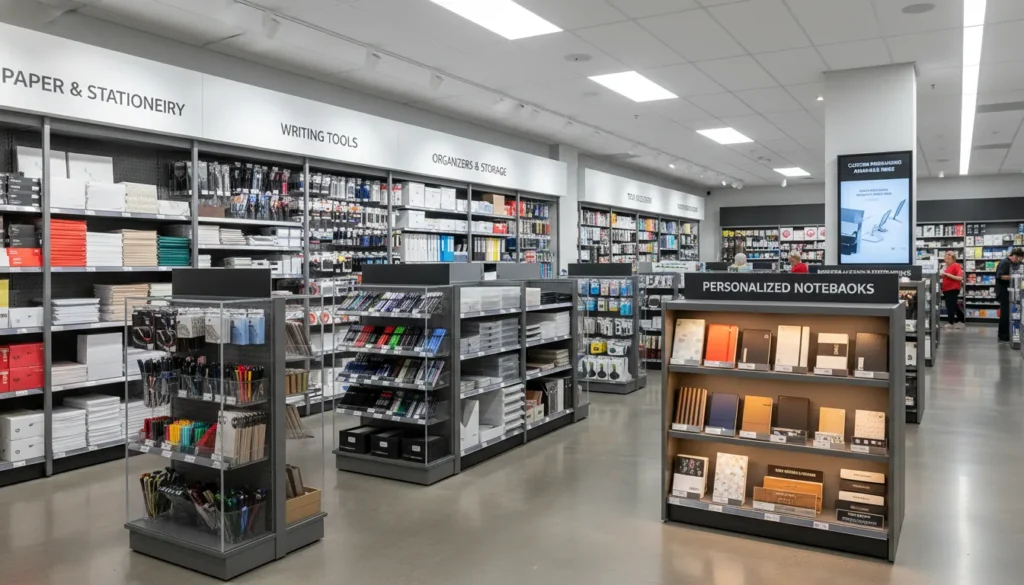
The office has a personality now. Some teams want minimalist desk setups, others need heavy-duty shipping and filing, and many want branded supplies that look sharp on camera. That’s why office supplies retailers aren’t just “where you buy paper”—they’re part of how a workplace runs, budgets, and presents itself. So how do you pick the right retailer, avoid hidden costs, and still deliver a better employee experience?
In this guide, I’ll break down what top office supplies retailers do well, where they often fall short, and how modern retailers are adding high-margin personalization with tools like laser engraving and print-on-demand.

What “Office Supplies Retailers” Really Means in 2026
Office supplies retailers typically fall into a few categories, each optimized for different buying behaviors. Some excel at breadth (everything from staples to chairs), while others win on procurement controls, bulk pricing, or niche design-forward products.
Most buyers are balancing four forces:
- Availability (can you get essentials fast?)
- Total cost (not just unit price—shipping, returns, stockouts)
- Standardization (consistent SKUs across locations)
- Experience (employee satisfaction, brand consistency, sustainability)
When I’ve helped teams set up supply programs, the biggest surprises were almost always “soft costs”: time spent chasing backorders, inconsistent item quality, and unmanaged maverick spend.
The Main Types of Office Supplies Retailers (Pros, Cons, Best Fit)
1) Big-box office superstores (online + stores)
These office supplies retailers are known for broad selection: paper, pens, furniture, tech, and printing services. They’re a strong default choice if you need one vendor that can cover many categories.
Best for:
- Mixed needs (facilities + admin + IT basics)
- Teams that value in-store pickup and easy returns
Watch-outs:
- Pricing can vary widely by brand and promo cycles
- Some SKUs change frequently, which complicates standardization
2) Business-focused contract suppliers (B2B procurement)
These retailers focus on business accounts, approval workflows, and consolidated invoicing. If you manage multiple departments or locations, this is often the cleanest operationally.
Best for:
- Procurement teams, schools, healthcare admin, multi-site orgs
- Spend controls and reporting
Watch-outs:
- Smaller “creative” assortments
- Customization may be limited unless you integrate a separate solution
3) Bulk/industrial and shipping-oriented suppliers
Some office supplies retailers overlap with warehouse and packaging supply. They shine when “office supplies” includes shipping, labeling, safety items, and warehouse-adjacent needs.
Best for:
- Operations-heavy businesses
- High-volume consumables (labels, boxes, gloves, cleaners)
Watch-outs:
- Desk aesthetics and branded gifting can be an afterthought
4) Design-led specialty retailers
These retailers win on minimalist organization, premium stationery, and desk lifestyle. They can be great for executive offices, client-facing spaces, or employee gifting.
Best for:
- Brand-forward companies
- Onboarding kits and premium desk setups
Watch-outs:
- Higher unit costs
- Less suited for bulk replenishment
| Retailer Type | Best For | Strengths | Common Gaps | Typical Delivery Speed |
|---|---|---|---|---|
| Big-box superstores | General office restocking; small businesses | Broad assortment; frequent promos; easy returns | Inconsistent stock; limited account tools | Same-day to 3 business days |
| B2B contract suppliers | Medium–large organizations; managed spend | Contract pricing; procurement integration; analytics | Higher minimums; less flexible for one-off purchases | Next-day to 5 business days |
| Bulk/industrial suppliers | Warehouses; facilities; high-volume buyers | Low unit cost at scale; industrial-grade options | Large pack sizes; fewer consumer brands; higher freight | 2 to 7 business days |
| Design-led specialty retailers | Client-facing offices; premium setups | Curated aesthetics; higher-quality materials; gifting | Higher prices; narrower selection; limited bulk deals | 2 to 5 business days |
What to Evaluate Before You Commit to an Office Supplies Retailer
Choosing among office supplies retailers is easiest when you score them on the same criteria. Here are the checks that consistently matter in real operations:
Assortment + substitution behavior
A retailer can list 50,000 SKUs, but what matters is whether your core list stays stable. Ask:
- Do they substitute without approval?
- Can you lock a “standard catalog” for your account?
Delivery performance and packaging quality
Late deliveries create “emergency runs,” which spike costs. Look for:
- On-time rate and cut-off times
- Damage rates (especially for paper, toner, and organizers)
Pricing model and transparency
Unit price is only half the story. Confirm:
- Shipping thresholds and fees
- Contract pricing vs promo pricing
- Return shipping and restocking fees
Account controls (for businesses)
For B2B buyers, the best office supplies retailers offer:
- Role-based approvals
- Budget caps by department
- Punchout catalogs and invoicing integration
Sustainability and compliance
More organizations now require:
- Recycled content paper options
- Reduced-plastic packaging
- Compliance documentation for certain products
The Retailer Trend That’s Changing the Category: Customization at the Point of Need
Many office supplies retailers are fighting margin pressure on commodity items (paper, pens, basic organizers). One of the most reliable ways to increase average order value—without just raising prices—is personalization.
Customization works because it:
- Differentiates products that are otherwise interchangeable
- Supports onboarding, recognition, and internal branding
- Enables small-batch runs (no warehouse full of pre-printed items)
I’ve tested personalization programs in retail-like environments, and the fastest wins usually come from items customers already buy—just upgraded with names, departments, or logos.
Examples that sell well:
- Engraved desk nameplates and door signs
- Branded notebooks, folders, and organizer labels
- Custom stamp alternatives (laser-marked templates, signage)
- Team onboarding kits with personalized items
If you’re exploring this angle specifically for office supply stores, this internal guide is directly relevant: how laser customization solves office supplies retail challenges.
How xTool Fits: Turning Office Supplies Retail Into a “Make It Personal” Business
xTool’s ecosystem is designed for creators and businesses that want to produce professional results quickly—without turning customization into a complicated production department. For office supplies retailers, that matters because speed, repeatability, and safety are non-negotiable.
Typical in-store or backroom customization workflows include:
- Laser engraving on coated notebooks, acrylic desk accessories, wood gift items
- Fast labeling systems for organizers and storage
- Small-batch corporate orders (new hires, events, recognition)
If you want to explore hardware options, start here: all products except apparel printer metalfab. For merchandising ideas that already match office buying behavior, this resource is useful: 15 Best Personalized Office Gifts for Employees.
What to pilot first (low risk, high learning)
- Top 10 customizable SKUs (notebooks, nameplates, acrylic organizers, desk signs)
- A 2–3 day turnaround promise for local business customers
- A simple pricing ladder (base item + personalization fee + rush fee)
This is where office supplies retailers can win: you keep essentials in stock, then add customization as the premium layer.
Lasercrafting Personalized Office Name Plate With Optional Wall or Desk Holder – 2×8 – CUSTOMIZE. C
Common Retail Pain Points (and Practical Fixes)
Even strong office supplies retailers run into the same operational snags. Here’s what I see most often—and what actually helps.
- Stockouts of core essentials
- Fix: create a protected “never out” list and set reorder triggers
- Maverick spend across teams
- Fix: approvals + a curated catalog + monthly spend review
- Low margins on commodity categories
- Fix: bundle essentials with personalized add-ons (kits, onboarding packs)
- Returns and damage costs
- Fix: tighten packaging standards; track damage by carrier and SKU
- Seasonal demand spikes (back-to-school, fiscal year-end)
- Fix: pre-build promo kits and reserve inventory early
Authoritative Resources (For Benchmarking and Category Research)
To compare assortments, shipping expectations, and category structure across major office supplies retailers, these are useful starting points:
FAQ: Office Supplies Retailers
1) What are the best office supplies retailers for small businesses?
Look for retailers with reliable delivery, easy returns, and business pricing tiers. Small businesses often benefit from a big-box retailer for breadth or a B2B supplier for invoicing and controls.
2) How do I reduce office supply costs without lowering quality?
Standardize a core SKU list, limit substitutions, and track total cost (shipping, returns, emergency purchases). Bundling predictable replenishment with fewer vendors also reduces admin time.
3) Do office supplies retailers offer business accounts with approvals?
Many do. Ask about role-based permissions, spend caps, invoice consolidation, and punchout catalog support if you use procurement software.
4) What office supplies should be standardized across locations?
Paper, toner/ink, pens, folders, labels, basic cleaning/breakroom items, and key ergonomic accessories. Standardization reduces training time and prevents incompatible purchases.
5) Can office supplies retailers profit from personalization?
Yes—personalization increases perceived value and reduces direct price comparison. Engraved or printed items also support corporate gifting, onboarding, and events.
6) What items are easiest to personalize in an office supply store?
Notebooks, desk nameplates, acrylic organizers, signage, and giftable desk accessories. These are lightweight, high-visibility, and usually quick to customize.
7) How fast can customized office supplies be fulfilled?
With the right workflow, many items can be turned around in 24–72 hours. Speed depends on material prep, design approval, and batching.
Conclusion: The Best Office Supplies Retailers Don’t Just Restock—They Help You Run Better
At the end of the day, office supplies retailers succeed when they make work feel frictionless: the essentials arrive on time, costs stay predictable, and teams get tools they actually like using. The next wave of winners will go further—adding personalization that turns ordinary supplies into branded, high-margin products customers can’t get from a generic catalog.
If you’re considering a modernization push—better procurement, better merchandising, or a personalization pilot—share what kind of customers you serve (B2B, school, walk-in retail) and what your top 20 SKUs are. I’ll suggest a practical starting mix.
📌 xTool Apparel Printer: One Click DTF Printer, Effortless Customization for Business